

Muse Spark 1.1 is Meta Superintelligence Labs’ new multimodal model, unveiled on July 9, 2026 and built for agentic tasks: planning, using tools, operating a computer and coding, with a one-million-token context window. It tops agent and tool-use benchmarks like MCP Atlas and Humanity’s Last Exam, while staying very affordable through the new Meta Model API, priced at 1.25 dollars for input and 4.25 dollars for output per million tokens. On pure coding, though, it still trails GPT-5.5 and Claude Opus 4.8. In a rare move, Mark Zuckerberg returned to X after three years of silence to announce it.
Muse Spark 1.1, Meta’s new model

Meta unveiled Muse Spark 1.1 on July 9, 2026. It is a multimodal reasoning model, presented in Meta’s official announcement as a major update to the first Muse Spark and another step toward the “personal superintelligence” the company is chasing.
Its distinctive trait is not generating pretty images but taking action: chaining steps, wielding tools and carrying out long tasks on your behalf. It is a model built for agents, not just for conversation.
A model from Meta Superintelligence Labs
Muse Spark 1.1 is the second model from Meta Superintelligence Labs, the division Mark Zuckerberg set up to catch up with OpenAI, Google and Anthropic. It arrives alongside Muse Image, dedicated to visual generation.
The stated goal is clear: deliver a model that is both strong on agentic work and code, and clearly cheaper than the competition. It is also a showcase for Meta’s AI ecosystem, long powered by open models such as Meta’s Llama.
Muse Spark 1.1 or musespark.ai? Don’t mix them up
Watch out for a common trap. Muse Spark, written as two words, is Meta’s AI model, the subject of this article. musespark.ai, written as one block, is a third-party image and video generation platform with no connection to Meta.
Nearly the same name, completely different projects. If you are looking for Meta’s model, Muse Spark 1.1 is indeed the one you want.
What can Muse Spark 1.1 do?
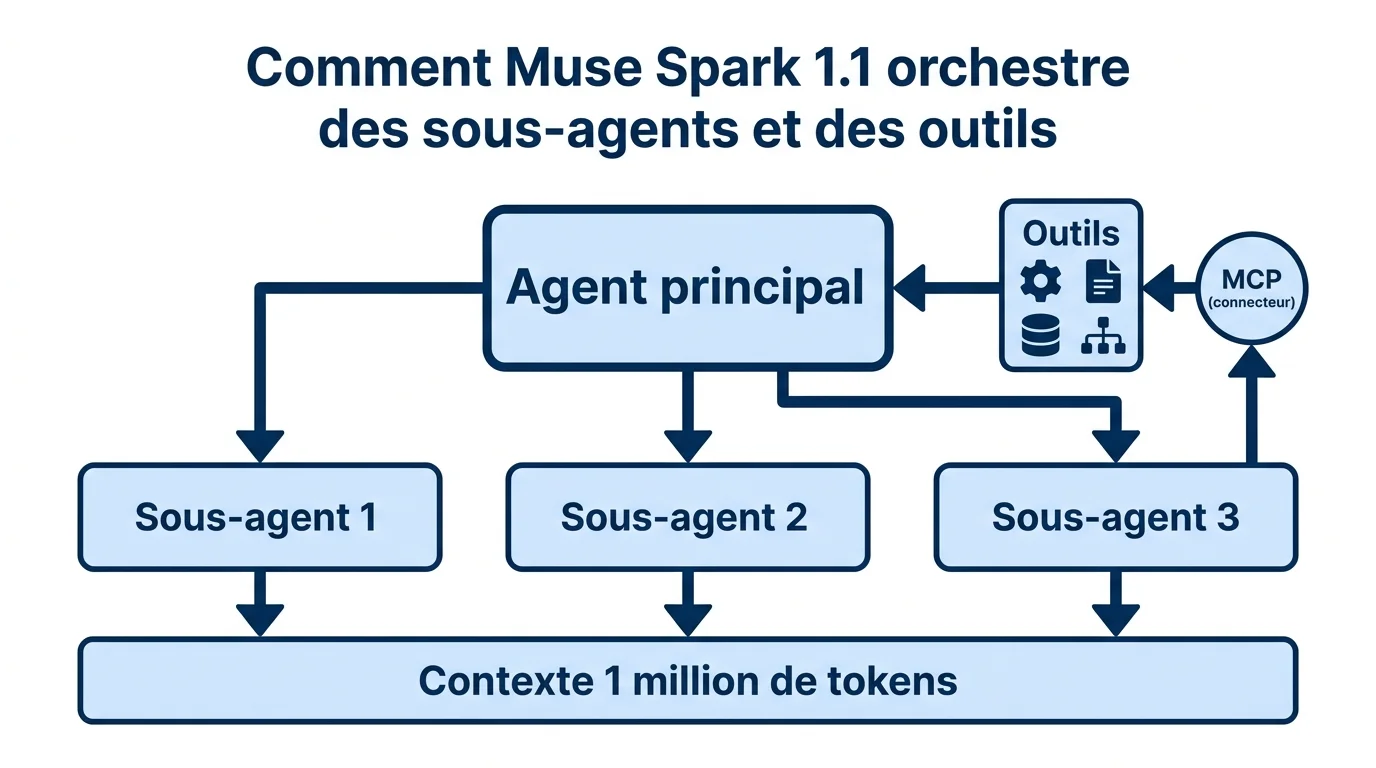
Muse Spark 1.1 improves on three fronts over its predecessor: agentic ability, computer control and coding, without forgetting multimodality. The guiding idea stays the same: move from thinking to acting autonomously.
Agents, tool use and a one-million-token context
The model can plan a complex task, break it down and hand execution to sub-agents working in parallel. It generalizes to new tools, MCP servers and skills without retraining, from the very first use.
Its one-million-token context window is actively managed. It remembers its actions, retrieves information seen much earlier and compacts history while keeping the steps that genuinely matter next.
Computer control and coding
Muse Spark 1.1 drives interfaces on desktop, mobile and browser. It decides when to write a script to go faster and when to click directly, and it generates batches of actions at each step rather than reasoning click by click.
On the coding side, it diagnoses complex bugs, adds features to large systems and runs whole migrations. It plugs into common agentic coding environments, with planning mode, delegation to sub-agents and context compaction.
Multimodal capabilities
The model also reasons over images and video. It excels at generating code from a visual, describing images and videos in detail, and taking actions based on what it perceives.
Meta cites a telling example: from a video shot on a smartphone, Muse Spark 1.1 pulls the right photos, reasons about the product and creates a Facebook Marketplace listing all on its own.
Muse Spark 1.1 versus GPT-5.5, Claude Opus 4.8 and Gemini
Meta published a battery of benchmarks comparing Muse Spark 1.1 with Gemini 3.1 Pro, Claude Opus 4.8 and GPT-5.5. The verdict is clear: the model crushes the panel on agentic work and tool use, but concedes on pure coding.

Muse Spark 1.1 posts record scores on agent benchmarks (MCP Atlas 88.1, JobBench 54.7), but stays behind GPT-5.5 and Claude Opus 4.8 on pure coding.
On agent tasks, Muse Spark 1.1 racks up records: MCP Atlas at 88.1, JobBench at 54.7, Humanity’s Last Exam at 62.1 and Finance Agent v2 at 57.2, ahead of the Claude Opus line and OpenAI’s GPT models.
| Muse Spark 1.1 on top | Muse Spark 1.1 beaten |
|---|---|
| MCP Atlas (88.1) | Terminal-Bench 2.1, by GPT-5.5 |
| JobBench (54.7) | SWE-Bench Pro, by Claude Opus 4.8 |
| Humanity’s Last Exam (62.1) | DeepSWE 1.1, by GPT-5.5 |
| Finance Agent v2 (57.2) | CharXiv and BabyVision, by Opus and GPT-5.5 |
In short, Claude Opus 4.8 takes back the lead on software engineering and chart reasoning, while GPT-5.5 dominates terminal coding and visual reasoning. An independent evaluation by Artificial Analysis ranks it just below GPT-5.5 on coding, but among the cheapest coding agents on the market.
Muse Spark 1.1 (xhigh) scores 69 on the Artificial Analysis Coding Agent Index in the Opencode harness, offering a strong blend of performance and near frontier cost-efficiency. Muse Spark 1.1 lands just below GPT-5.5 (medium) in Codex (71) and ahead of Claude Opus 4.8 (medium) in Claude Code (67). Cost per task is among the lowest of frontier coding agents at ~$1.4.
Artificial Analysis (@ArtificialAnlys) July 11, 2026
How much does the Muse Spark 1.1 API cost?
This is Meta’s other selling point: price. The new Meta Model API bills Muse Spark 1.1 at 1.25 dollars per million input tokens and 4.25 dollars for output, a very aggressive rate for a model at this level.
Zuckerberg back on X and the AI price war
The announcement made waves for an unexpected reason. Mark Zuckerberg posted on X for the first time in over three years to share it, reviving his old rivalry with Elon Musk’s network along the way.
At 1.25 dollars for input and 4.25 for output per million tokens, Muse Spark 1.1 undercuts GPT-5.5 and Claude Opus 4.8 on price.
The message is clear: Meta is going after OpenAI and Anthropic on value for money, where its rivals often charge far more for token generation. By describing it as a powerful agentic and coding model at a very low price, Zuckerberg positions Muse Spark 1.1 as the option for running agents at scale without blowing your budget.
(1) Today we’re releasing Muse Spark 1.1 — a strong agentic and coding model at a very low price. It’s available through our new Meta Model API and in Meta AI.
Mark Zuckerberg (@finkd) July 9, 2026
How to try Muse Spark 1.1?

Muse Spark 1.1 is already available through several channels, from consumer to developer.
| Access channel | Detail |
|---|---|
| Meta AI app | Available in “Thinking” mode |
| meta.ai (browser) | Available in “Thinking” mode |
| Meta Model API | Public preview, OpenAI-compatible |
For developers, compatibility with OpenAI’s API format makes switching much easier. Most of the time you just change the endpoint and the key to test the model in an existing project.
Frequently asked questions about Muse Spark 1.1
Is Muse Spark 1.1 free?
You can try it for free in the Meta AI app and on meta.ai, in “Thinking” mode. API access through the Meta Model API is paid, at 1.25 dollars for input and 4.25 dollars for output per million tokens.
Is Muse Spark 1.1 better than GPT-5.5 and Claude Opus 4.8?
It depends on the use case. Muse Spark 1.1 beats its rivals on agentic work and tool use, but stays behind GPT-5.5 and Claude Opus 4.8 on pure coding tasks.
How large is Muse Spark 1.1’s context?
The model has a one-million-token context window, which it actively manages by retaining key actions and compacting history over the course of a long task.
Are Muse Spark 1.1 and musespark.ai the same thing?
No. Muse Spark 1.1 is Meta’s AI model, while musespark.ai is a third-party content generation platform. The two have similar names but no connection.


