

Meta has just launched the new version of its open-source language models, Llama.
This major update, named Llama 3.1, brings its share of new features and significant improvements.
Let us break down this announcement that marks an important milestone in the development of generative AI.
Llama 3.2 is now available, you can find the new features here.
The new Meta Llama 3.1 models (8B, 70B, and 405B)
The Llama 3.1 family consists of three models of different sizes: 8B, 70B, and 405B. The flagship model, Llama 3.1 405B, is presented as the first open-source model capable of competing with the best proprietary models in terms of performance and capabilities.
The 8B and 70B models have also been improved, notably with the addition of multilingualism (8 supported languages), an extended context length of 128K tokens, and enhanced reasoning capabilities.
These models cover a wide range of use cases, from summarizing long texts to coding assistants and multilingual conversational agents.
Main improvements compared to previous Llama versions
Quantity and quality of training data
Meta has significantly improved the quantity and quality of data used to pre-train and fine-tune the Llama 3.1 models.
More advanced preprocessing and curation pipelines have been implemented, along with more rigorous filtering and quality assurance approaches for fine-tuning data.
Architecture and training optimizations
The architecture of Llama 3.1 models has been optimized to allow very large-scale training (up to 16,000 GPUs for the 405B model).
Meta opted for a simple but effective transformer architecture, avoiding more complex models like mixture-of-experts (MoE) in order to prioritize training stability.
The fine-tuning process has also been improved, with the introduction of an iterative procedure combining supervised fine-tuning, preference optimization, and high-quality synthetic data generation at each cycle.
Key characteristics of the Llama 3.1 models
Multilingualism
The Llama 3.1 models now support 8 languages, paving the way for many multilingual applications.
This capability has been leveraged by SNCF Gares & Connexions to develop a traveler information and guidance system in 6 languages.
Complex reasoning and external tool usage
Llama 3.1 stands out for its advanced reasoning capabilities, as demonstrated by its excellent results on benchmarks such as GSM8K or MATH.
The models are also capable of interacting with external tools and APIs, which considerably extends their scope of application (chart generation, data retrieval, etc.).
Synthetic data generation and model distillation
The quality of outputs generated by Llama 3.1 405B is such that the model can be used to produce synthetic data for training and improving smaller models.
This is a major advancement for democratizing model distillation techniques, previously reserved for labs with considerable resources.
API pricing comparison with ChatGPT 4o and Claude Sonnet 3.5
Meta highlights the competitiveness of Llama 3.1 models in terms of cost per token. Here is a comparison of API rates (in dollars per million tokens) for real-time inference:
| Model | Input | Output |
|---|---|---|
| Llama 3.1 8B | $0.30 | $0.60 |
| Llama 3.1 70B | $2.65 | $3.50 |
| Llama 3.1 405B | $5.33 | $16.00 |
| ChatGPT 4o | $5.00 | $15.00 |
| Claude Sonnet 3.5 | $3.00 | $15.00 |
| ChatGPT Mini 4o | $0.15 | $0.60 |
We can see that the Llama 3.1 models, although open source, remain competitive in terms of price compared to proprietary API offerings like ChatGPT 4o or Claude Sonnet 3.5.
Model performance evaluations on different benchmarks
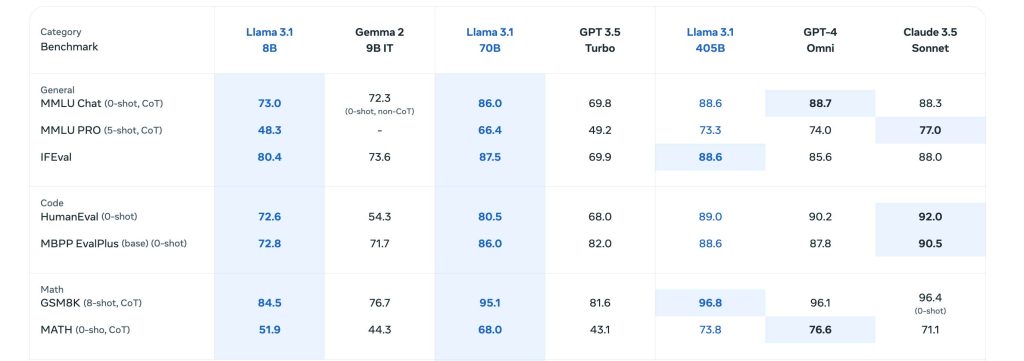
Meta evaluated the performance of Llama 3.1 models on over 150 datasets covering a broad spectrum of tasks and languages.
Thorough comparative evaluations were also conducted against competing models in real-world usage scenarios.
Results show that Llama 3.1 405B is on par with the best models on the market across many benchmarks:
- General knowledge: 88.6% on MMLU, 73.3% on MMLU PRO
- Mathematical reasoning: 96.8% on GSM8K, 73.8% on MATH
- External tool usage: 92.3% on API-Bank, 35.3% on Gorilla Benchmark
- Multilingualism: 91.6% on Multilingual MGSM
The 8B and 70B models also show excellent performance, with a very attractive capability-to-cost ratio for many use cases.
My opinion on Llama 3.1
We are looking at an open-source model that will be able to compete with the smaller models from OpenAI and Anthropic.
However, the fact that the model is open source makes its usage slightly more complex and reserved for advanced users, for now.
Potential and use cases of Llama 3.1 models for developers
A mature open-source ecosystem
With over 25 partners at launch (AWS, NVIDIA, Databricks, etc.), the Llama 3.1 ecosystem offers developers a wide choice of services and tools to easily leverage all model capabilities: real-time or batch inference, fine-tuning, evaluation, synthetic data generation, etc.
Meta also provides an open-source reference system including application examples and key components like Llama Guard 3 (multilingual safety model) or Prompt Guard (prompt injection filter).
Standardization efforts around the Llama Stack aim to promote interoperability among all ecosystem players.
Diverse use cases already experimented
Despite their recent release, Llama 3.1 models have already been successfully used in very diverse domains:
- An AI study companion deployed on WhatsApp and Messenger
- A language model specialized in the medical field to assist clinical decision-making
- A Brazilian startup using Llama 3.1 to facilitate the management and communication of patient hospitalization data
These examples are just a glimpse of the application potential of these models.
With the power of open-source and the unique capabilities of Llama 3.1, the possibilities are immense for building the next generation of innovative and useful AI experiences.


