

The meteoric rise of conversational artificial intelligences like ChatGPT, Claude, or Deepseek has revolutionized how we interact with technology.
These virtual assistants, capable of generating text, answering complex questions, and even coding, fascinate as much as they worry.
While their potential seems unlimited, these AIs raise numerous questions regarding personal data protection and privacy.
What are the real risks and how can you effectively protect yourself? Let’s dive into the heart of this major issue in the digital age.
How conversational AIs collect data
How language models work
Conversational AIs are based on language models trained on massive text corpora. These models analyze linguistic patterns to generate coherent responses. Each interaction with the user potentially enriches the AI’s knowledge base.
They primarily collect conversation content, but also metadata such as time, duration of exchanges, or approximate location. Some systems can also access browsing history or user account information.
| Data type | Examples | Potential use |
|---|---|---|
| Text content | Messages, queries | Model improvement |
| Metadata | Timestamps, location | Usage analysis |
| Account data | Email, preferences | Personalization |
How do AI companies use the data?
The collected data primarily serves to improve AI model performance. However, some companies may exploit them for commercial purposes or share them with third parties. Transparency about these practices varies among market players.
Implementing technical protections for your interactions
How to use a VPN to anonymize your connection
A virtual private network (VPN) encrypts internet traffic and masks the user’s real IP address. This technique complicates online activity tracking and strengthens the confidentiality of exchanges with conversational AIs. Choosing a reliable VPN provider is crucial to ensure optimal protection.
Choosing privacy-focused browsers and extensions
Browsers like Tor or Brave integrate advanced privacy protection features. Extensions like uBlock Origin or Privacy Badger block trackers and malicious scripts. These tools limit the collection of personal data during interactions with AIs.
Most AI platforms offer customizable privacy settings. It is recommended to study them carefully and configure them restrictively. Some paid services like ChatGPT Plus have privacy options.
Effectively managing your personal data with AIs
| AI Model | Uses user data for training | Opt-out option | Additional notes |
|---|---|---|---|
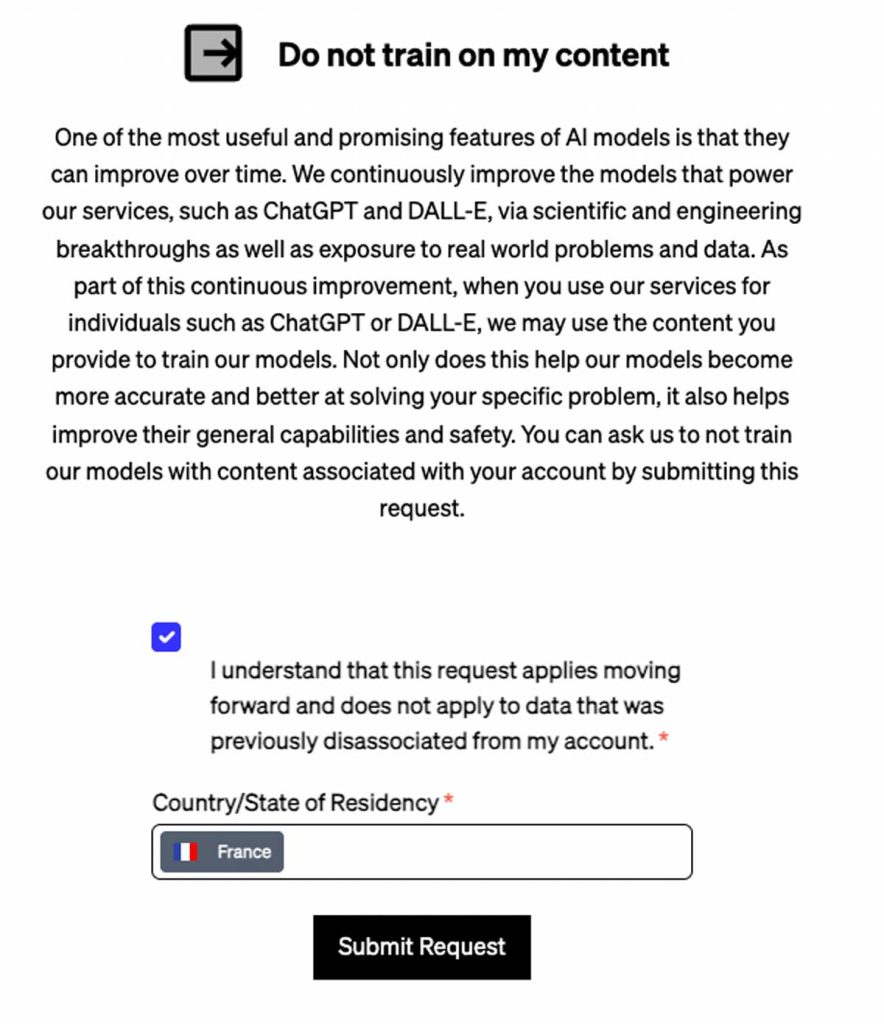
| ChatGPT (OpenAI) | Yes (by default for free plans) | Yes, via a form or settings | No training for paid plans like ChatGPT Business by default. |
| Claude (Anthropic) | No (by default) | Not necessary, except in specific cases with explicit consent | Used for safety, not for general training. |
| Google Gemini | Yes (for standalone Gemini Apps) | Yes, by turning off Gemini Apps activity | No training for Workspace and Cloud. |
| Microsoft Copilot | No (by default) | Not necessary, as no training occurs | GDPR compliant, data not shared with OpenAI. |
| Perplexity AI | Yes (by default) | Yes, by turning off AI data usage in settings | Data used to improve experience, not for third-party models. |
| DeepSeek | Yes | Unclear, possibly under certain conditions | Uses user data for model training, stored in China, with privacy concerns. |
| Mistral AI | Yes (except for certain paid services) | Yes, via account settings | User data is used for training for free and some paid subscriptions, except for Mistral Team, Enterprise, and API, where it is not used. Users can opt out via account settings. |
Note that you can ask ChatGPT not to train their models with your data by visiting this address.
How to limit shared sensitive information
Caution is advised regarding personal data shared with AIs. Avoid sharing sensitive information such as bank details, passwords, or confidential documents. Prefer using fictional or anonymized examples during exchanges.
How to regularly clear your history
Most AI platforms allow you to delete conversation history. This practice limits the risk of data leaks in case of hacking. Regular cleaning also prevents the accumulation of personal information on the company’s servers.
The General Data Protection Regulation (GDPR) grants European users rights over their personal data. These rights include access, rectification, and deletion of collected information. Do not hesitate to exercise them with AI providers to maintain control over your data.
Applying advanced authentication and security methods
How to enable two-factor authentication
Two-factor authentication (2FA) adds an extra layer of security to user accounts. This method generally combines a password with a temporary code sent via SMS or generated by a dedicated application. 2FA significantly reduces the risk of AI account hacking.
How to use a password manager
Password managers allow you to create and store complex and unique passwords for each service. These tools strengthen AI account security by avoiding the reuse of compromised passwords. They also facilitate the management of multiple credentials.
Prompt injection attacks aim to manipulate the behavior of conversational AIs. To protect against them, you need to understand the mechanisms of these attacks, as explained in this article on the definition and examples of prompt injection. Vigilance and the application of best practices limit the risks of malicious AI exploitation.
| Security method | Advantages | Disadvantages |
|---|---|---|
| 2FA Authentication | Enhanced protection | Longer login process |
| Password manager | Unique and complex passwords | Dependence on a third-party tool |
| Anti-injection vigilance | Prevention of manipulations | Requires technical knowledge |
Adopting daily digital hygiene with AIs

How to educate and raise awareness among those around you
Protecting privacy against AIs concerns all users. Sharing your knowledge and best practices with those around you contributes to creating a safer digital environment. Parents have a particular role to play in educating children about online privacy issues.
How to stay informed about technological and legal developments
The AI field is evolving rapidly, as are associated regulations. Staying up to date with the latest technological advances and legislative changes allows you to adapt your practices. Here are some reliable information sources:
- Websites specialized in artificial intelligence
- Cybersecurity expert blogs
- Official publications from data protection authorities
- Newsletters from major industry players
A periodic review of your AI usage habits helps identify potential vulnerabilities. This personal audit can include:
- Reviewing privacy settings on each platform
- Checking permissions granted to applications
- Analyzing interaction history to spot potential anomalies
- Testing implemented security mechanisms (VPN, 2FA, etc.)


