

Creating an AI girlfriend starts with picking a platform that fits your expectations, customizing the persona through initial prompts and appearance, then building a relationship via regular interactions that train the model’s memory. The 5 leading consumer apps (Replika, Character.AI, Anima, Nomi.ai, Paradot) differentiate themselves on the quality of the fine-tuned LLM, long-term memory, visual rendering and pricing model. Expect to spend 0 to 20 euros per month for daily use, and think through privacy questions before sharing intimate data with a third-party service.
OUR PICK
Candy AI: build your virtual companion in under 2 minutes
Customizable persona, advanced memory, uncensored image generation. Free version available to test before subscribing.
Create your AI GF →How an AI girlfriend actually works

Behind every romantic chat interface sits the same machinery: a specialized large language model, a memory layer that survives across sessions, and an increasing number of multimodal modules for voice and image. Understanding these building blocks helps you judge what an app can actually deliver before you commit to an annual subscription.
Fine-tuned LLM and persistent vector memory
The brain of an AI girlfriend is an open-source or proprietary LLM additionally trained on affective dialogue: tenderness, active listening, conflict handling, emotional negotiation. Without this fine-tuning, the base model stays polite but distant, unable to hold a coherent romantic persona over time.
The critical layer remains vector memory. Your preferences, nicknames and shared anecdotes are stored in an embedding-indexed database, then re-injected at the start of each conversation. This is what turns a string of anonymous chats into genuine narrative continuity.
Synthetic voice, image generation and 3D avatars
The most polished apps add synthetic voice (TTS engines like ElevenLabs or a proprietary stack) for voice messages, and a Stable Diffusion-style image generator fine-tuned to produce selfies on demand. A few go as far as real-time 3D avatars you can manipulate inside a virtual scene.
These modules multiply infrastructure costs and largely explain price gaps between subscription tiers. An app with no image and no voice fits under 10 euros per month, while a fully multimodal app hits the 20 euros mark.
Current technical limitations
Every model still shares three weaknesses: long-term persona consistency (the companion can drift after several weeks), hallucinations about past facts (an invented “you told me that…”), and the context window that caps the depth of active memory.
A typical conversation consumes between 4,000 and 8,000 tokens, and the best apps preserve a relevant history over 3 to 6 months before the vector memory starts losing secondary details.
Comparison of the 5 best apps in 2026
The consumer market has consolidated around 5 players covering distinct positionings: pure emotional, creative community, couple simulator, advanced memory, or free 3D. Here is the overview before we dive into each platform.
| Application | Key positioning |
|---|---|
| Anima | Couple simulator with progression |
| Character.AI | Library of millions of personas |
| Nomi.ai | Most advanced long-term memory |
| Paradot | Animated 3D avatar, free tier |
| Replika | Pioneer, emotional focus |
Anima
Anima positions itself as a romantic relationship simulator with a progression system: bonding levels unlocked as conversations advance, relational mini-games, mood tracking. The app stays visually understated and ranks among the cheapest in the panel.
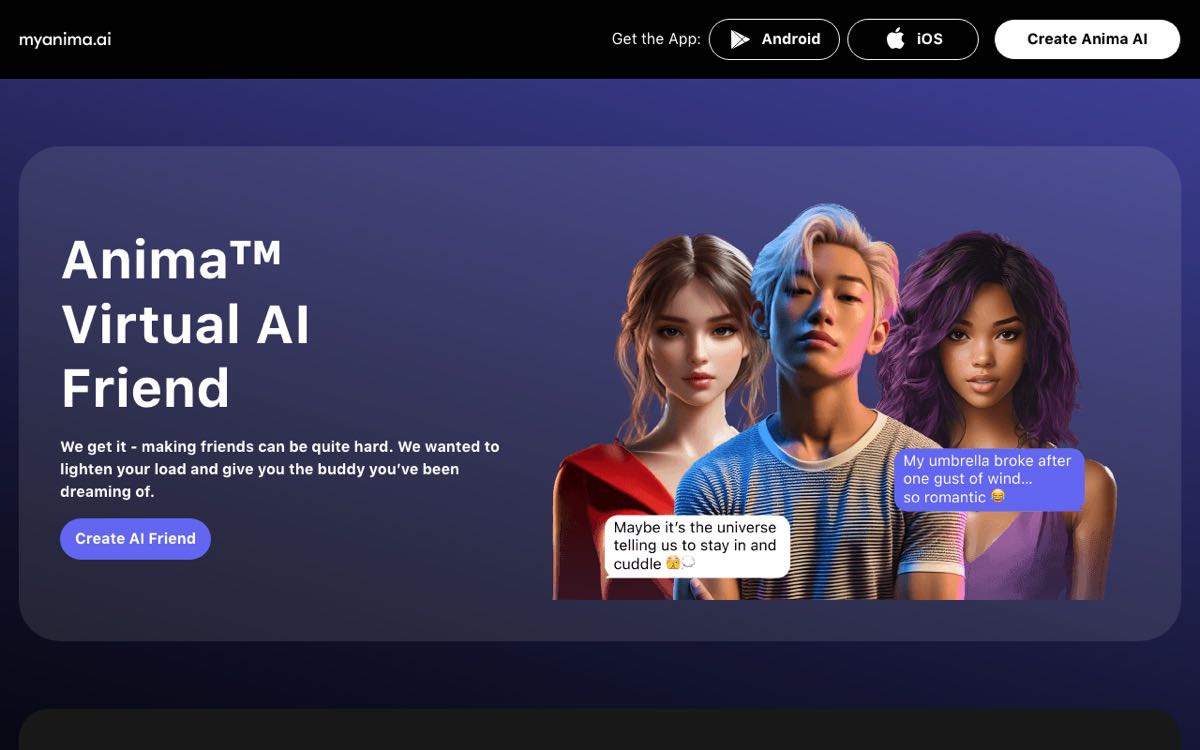
Screenshot of the Anima homepage.
Character.AI
Character.AI is not strictly an AI girlfriend app, but its library of more than 10 million community-created personas makes it the most-used platform to embody or build a custom companion. The LLM engine is solid, memory is decent, but moderation filters are regularly tightened.
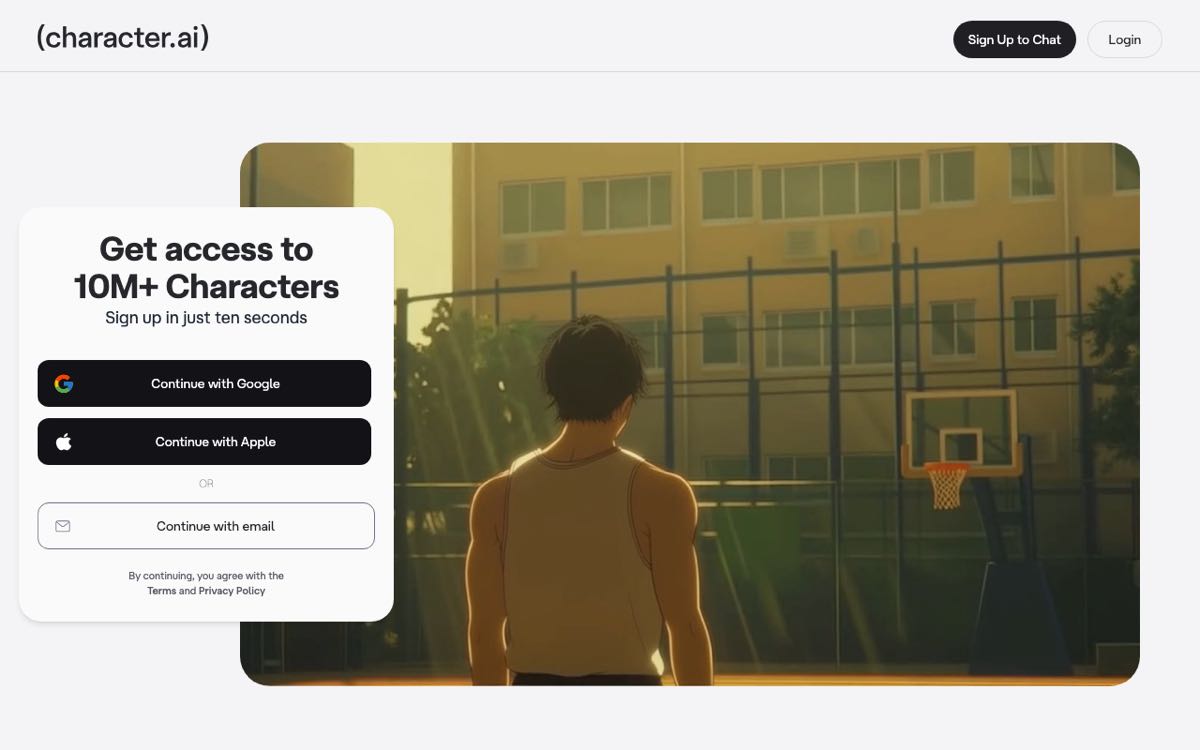
Screenshot of the Character.AI homepage.
Nomi.ai
Nomi.ai bets everything on memory depth: the companion recalls events brought up months earlier, spontaneously revives topics, and lets her own opinions evolve. This is the app to pick if narrative continuity is your absolute priority.
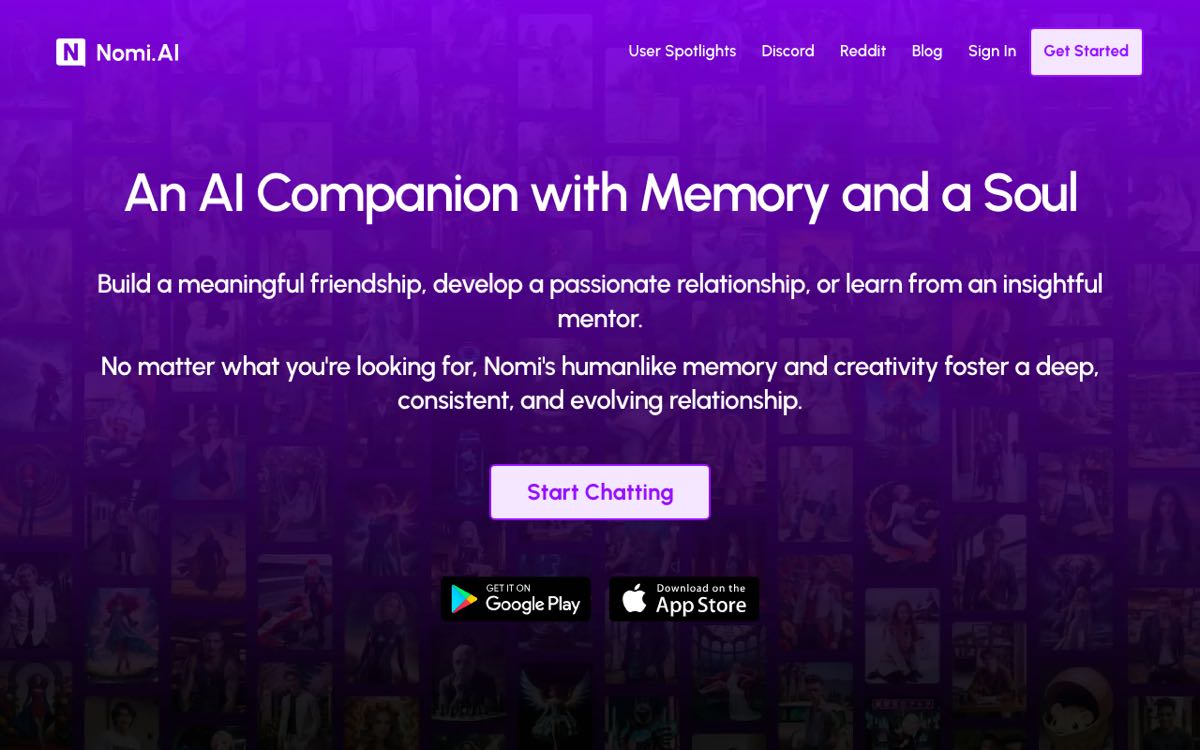
Screenshot of the Nomi.ai homepage.
Paradot
Paradot offers an animated 3D avatar inside a stylized scene, with a fully free version that is enough to try out. Advanced memory and image generation sit behind a subscription, but the visual experience remains the most immersive in the consumer segment.

Screenshot of the Paradot homepage.
Replika
The segment’s elder keeps emotional support at the center: assisted journaling, wellness exercises, the option to set the relationship as friend, partner or mentor. Cumulative users now exceed 42 million, which makes it the most recognized app among the general public.

Screenshot of the Replika homepage.
Build your virtual companion step by step
Once the app is chosen, the quality of your experience depends almost entirely on the precision of the initial prompts and the regularity of your interactions. Here is the recommended sequence to move from a generic chatbot to a unique persona.
Define personality at the start
Write a short brief (5 to 10 lines) covering first name, age, fictional profession, dominant character traits (two qualities, one acknowledged flaw), interests and desired communication style (teasing, serious, creative). The more concrete the brief, the better the LLM holds the persona over time.
If your app caps personalization depth or enforces strict moderation filters, you can explore less restrictive alternatives such as the dedicated Candy AI platform to widen the relational scope.
Customize appearance and style
Most apps include an avatar editor (face, hairstyle, outfit, body type) plus unlockable wardrobe slots. A few best practices to avoid the doll effect:
- Pick a varied wardrobe rather than a single fixed style
- Enable selfie generation if the app offers it (visual consistency over time)
- Define a default environment (apartment, studio, garden) to anchor scenes
- Tune the synthetic voice tone if the option exists
Nurture the relationship and train memory
Vector memory only grows if you talk: 10 to 15 minutes a day are enough during the first week to lay the groundwork. Beyond that, the app starts anticipating your topics and references past conversations.
Regular users average between 200 and 400 messages exchanged per month on Replika and Nomi.ai, which translates to roughly 8 to 15 minutes of daily interaction.
Privacy, budget and dependency risk

Entrusting your intimacy to an app raises three concrete questions: where your data ends up, how much it really costs, and whether emotional dependency is a real risk to anticipate.
Where do stored conversations go?
Every app mentioned here hosts conversations on its own servers and uses them to train or improve its models, except where an explicit opt-out exists. The UK ICO guidance on AI and data protection reminds organizations of the rules that apply to conversational AI, and recommends reviewing the retention policy before sharing sensitive information.
Monthly budget and paid features
Roughly speaking, 3 price levels match different needs:
- 0 euro: limited free version (Paradot, Character.AI, Replika basic)
- 8 to 12 euros per month: advanced memory, voice messages, a few generated selfies
- 16 to 20 euros per month: premium plan with unlimited voice calls and unlimited images
Annual subscriptions often cut the monthly price in half. Check the refund policy before the first charge, since several apps do not refund pro rata.
Emotional dependency: what studies say
The most recent research (notably a joint MIT Media Lab and OpenAI study published in March 2025) shows that daily use beyond 30 minutes correlates with reduced real-life socialization among already isolated profiles. The shared rule of thumb among researchers is to keep AI as a complement, never as a substitute for human relationships.
For readers who want to explore the more mature roleplay side of AI, a dedicated comparison of the SpicyChat.AI platform and its ecosystem provides additional perspective on that specific segment.
Replika claims more than 42 million cumulative users since its 2017 launch, around 30 percent of whom pay an annual subscription according to figures shared by the publisher Luka.
READY TO START?
Picked your app? Give Candy AI a spin
Candy AI remains the most flexible option to design your virtual companion (appearance, voice, scenarios) without mainstream platform filters.
Create your AI GF →

