

Anthropic launched Claude Opus 5.5 on September 22, 2026, the first model in the Claude 5.5 family. It costs $4 per million input tokens and $20 per million output tokens, 20% less than Opus 5, and cache reads drop to $0.20. Anthropic places it at the level of Claude Fable 5.1 on most work, at a running cost 40% below Opus 5. The official charts show, however, that this saving is concentrated at the low and medium effort settings.
What Claude Opus 5.5 changes compared with Opus 5
Opus 5.5 keeps the technical envelope of Opus 5: a 1 million token context window, 128,000 output tokens and reliable knowledge up to June 2026. It is available from day one on the Claude API, Amazon Bedrock, Google Cloud and Microsoft Foundry, under the ID claude-opus-5-5. Anthropic commits not to retire it before September 22, 2027.
Introducing Claude Opus 5.5, the first model in our new Claude 5.5 family. It performs at the level of Claude Fable 5.1 for most tasks, and costs 40% less to run than Opus 5.
— Claude (@claudeai) September 22, 2026
The model also generates output more than 30% faster than Opus 5. On the subscription side, five-hour usage limits go up on the Pro, Max, Team and seat-based Enterprise plans, and every subscriber gets a rate limit reset they can save for later.
A price list down 20%, cache reads at $0.20
Every line of the price list goes down, but the one that matters most for agentic work is cache reads. They fall from $0.50 to $0.20 per million tokens, or 0.05 times the input price instead of 0.1 times on most other Claude models. Here is the price list as Anthropic publishes it in its documentation:
| Item, per million tokens | Opus 5.5 (Opus 5) |
|---|---|
| Input | $4 ($5) |
| Output | $20 ($25) |
| Cache reads | $0.20 ($0.50) |
| 5-minute cache writes | $5 ($6.25) |
| 1-hour cache writes | $8 |
| Batch processing | $2 input, $10 output |
| Fast mode (up to 2.5x faster) | $8 input, $40 output |
Fast mode is still a research preview and is only offered on the Claude API, not on partner clouds. To put these amounts in the context of the whole lineup, the full Claude pricing guide covers the other models and the subscriptions.
Opus 5.5 cache reads cost $0.20 per million tokens, 60% less than Opus 5. In an agentic session that rereads the same prefix on every turn, this is the line that weighs most on the bill.
Fable 5.1-level work for a fraction of the price
Anthropic does not present Opus 5.5 as stronger than Fable 5.1, but as a model that comes close for much less. Fable 5.1 is still billed $10 and $50 per million tokens, two and a half times the Opus 5.5 rate. The company adds that, in its own use, the gap between the two is narrower than the scores suggest.
An internal test illustrates it: translating HAProxy, a web load balancer written in C, into Rust. Both rewrites passed nearly all of the project’s regression tests, but Opus 5.5 finished in 9.5 hours versus 12 hours for Fable 5.1, at 51% lower cost. If you are weighing the two tiers, the Claude Fable 5.1 analysis explains what still justifies its price.
The official benchmarks, test by test
The values below come from the table published in Anthropic’s official announcement of September 22, 2026. Opus 5.5 scores are measured at max effort unless otherwise noted, with production safeguards enabled.
Agentic coding: Terminal-Bench, FrontierCode and CursorBench
On all three agentic coding tests, Opus 5.5 leads the table:
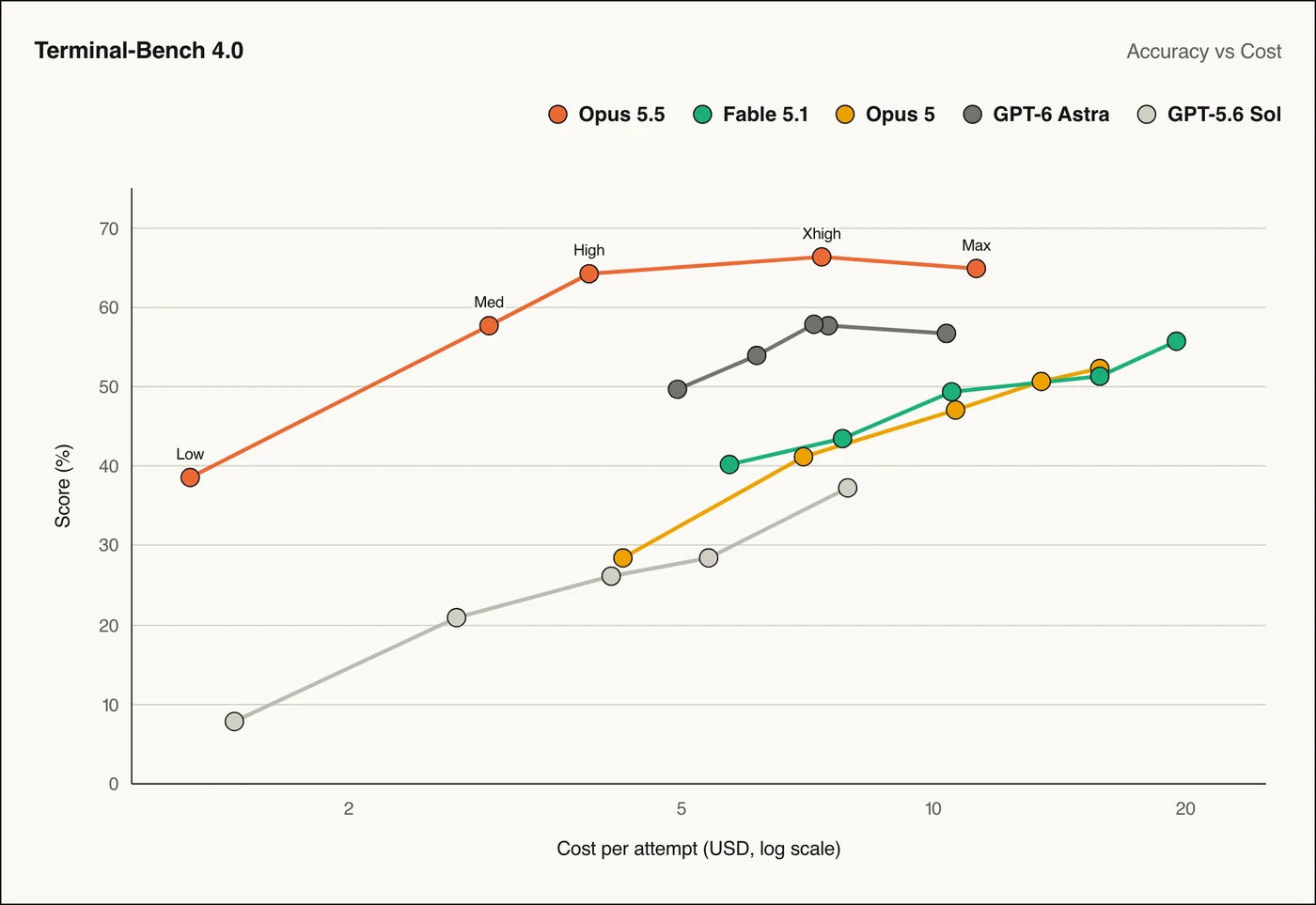
- Terminal-Bench 4.0: 66.4% at xhigh effort, versus 57.9% for GPT-6 Astra, 55.8% for Fable 5.1, 52.3% for Opus 5 and 37.3% for GPT-5.6 Sol;
- FrontierCode v1.1, which measures whether a code change would be merged: 54.4%, versus 53.3% for GPT-6 Astra and 50.3% for Fable 5.1;
- CursorBench 4.0, built from real Cursor sessions: 57.8%, versus 51.8% for Fable 5.1 and 46.6% for Opus 5.
The official Terminal-Bench 4.0 chart mostly shows the other axis, cost per attempt. At medium effort, its default setting, Opus 5.5 scores 57.6% for $2.94, while Opus 5 tops out at 52.3% at max effort for $15.83. GPT-6 Astra reaches an equivalent score, 57.9%, for $7.21.
Claude Opus 5.5 takes the top spot on the Artificial Analysis Intelligence Index, along with a 20% price cut and larger cache hit discount. Claude Opus 5.5 brings Anthropic to parity with GPT-6 Astra on evaluations like Terminal-Bench 4.0 and AutomationBench-AA
— Artificial Analysis (@ArtificialAnlys) September 22, 2026
Office work, research and computer use
Outside coding, Opus 5.5 leads on most rows, but not all of them. GPT-6 Astra keeps the edge on two tests, which the announcement shows openly:
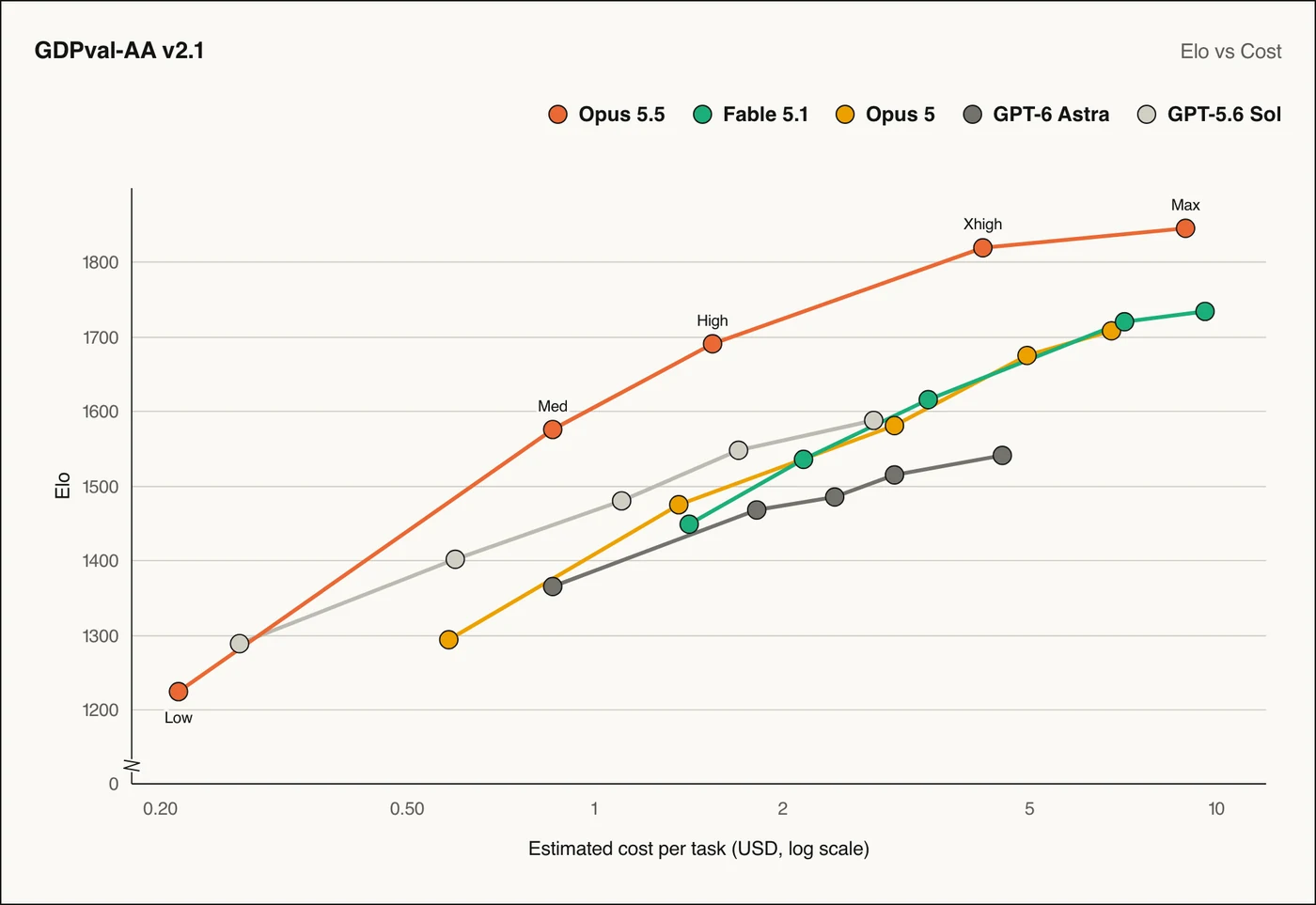
- GDPval-AA v2.1, real work across 44 occupations: 1846 Elo, versus 1735 for Fable 5.1, 1708 for Opus 5 and 1542 for GPT-6 Astra;
- Humanity’s Last Exam with tools: 67.7%, versus 65.6% for Fable 5.1 and 57.2% for GPT-6 Astra;
- OSWorld 2.1, operating a computer: 81.8%, versus 80.7% for Fable 5.1 and 74.0% for Opus 5;
- AutomationBench from Zapier: 40.0%, behind GPT-6 Astra’s 41.4%;
- Terminal-Bench-Science 0.1: 58.7%, behind GPT-6 Astra’s 64.6% but far ahead of Opus 5’s 29.0%.
One footnote deserves your attention. When safeguards triggered during the evaluations, cybersecurity tasks were completed by Claude Opus 4.8 and biology tasks by Opus 5, which likely pulls Opus 5.5’s scores down on those tests.
On research, Anthropic cites a test where every figure and quote in a report was checked against its sources. Opus 5.5 cleared the quality bar in 16 reports out of 18, while neither Fable 5.1 nor Opus 5 cleared it even once.
The 40% saving happens at low and medium effort
The announcement’s charts give, for each model, the score and the cost per task at each of the five effort levels: low, medium, high, xhigh and max. Read point by point, the “40% cheaper” claim varies a lot with the setting you choose.
Cost per task against Opus 5 at the same effort
On CursorBench 4.0, the test closest to everyday use inside an editor, here is what one task costs at each effort level:
| Effort | Opus 5.5 versus Opus 5 |
|---|---|
| Low | 43.7% for $1.18, versus 40.7% for $4.87 |
| Medium | 52.5% for $2.90, versus 43.3% for $6.94 |
| High | 56.0% for $3.97, versus 44.7% for $9 |
| Xhigh | 56.0% for $6.99, versus 46.1% for $11.43 |
| Max | 57.8% for $13.43, versus 46.6% for $11.95 |
Up to high effort, Opus 5.5 costs two to four times less than Opus 5 for a better score. At max effort, a task becomes more expensive than with Opus 5, by about 12%.
The same reversal shows up on GDPval-AA, where a task goes from $6.76 with Opus 5 to $8.92 with Opus 5.5 at max effort, 32% more. On AutomationBench, the gap is 8%. The documentation gives the reason: at the same setting, Opus 5.5 thinks more per turn than Opus 5, especially at xhigh and max.
At max effort, Opus 5.5 costs more per task than Opus 5 on GDPval-AA ($8.92 versus $6.76) and on CursorBench ($13.43 versus $11.95). The advertised saving comes from the low to high settings.
Max effort does not always give the best score
The second lesson from the curves: going all the way up does not pay on every test. On Terminal-Bench 4.0, Opus 5.5 scores 66.4% at xhigh for $7.35, then drops to 64.8% at max for $11.24. On FrontierCode, medium effort gives 54.6% for $0.80, better than the 54.4% at max for $6.19.
For your own workloads, start at medium, which is now the default, and only go higher if your evaluations justify it. If you are looking for a lighter option, look at Claude Sonnet 5.5, the tier below. Anthropic also recommends re-running your measurements rather than carrying over the setting you used with Opus 5.
Four API breaking changes before migrating from Opus 5
Changing the model ID is not enough. Anthropic’s migration documentation lists four changes that make requests fail when they used to work on Opus 5:
- Thinking can no longer be disabled. Sending
thinking: {"type": "disabled"}or a manual budget returns a 400 error; the effort parameter controls thinking depth. - Forced tool use is rejected. A
tool_choiceof typeanyortoolreturns a 400 error; keepautowith strict mode to get schema-valid JSON. - Thinking blocks are tied to the model and the conversation. Opus 5.5 reads Opus 5 blocks but not Fable or Mythos blocks, and accounts created since August 31, 2026 get an error if the history has been edited.
- The older computer_20251124 tool is rejected on the Claude API and Google Cloud, which now only accept the
computer_toolset_20260801toolset. Bedrock still accepts it.
What changes without causing an error
Two changes break nothing but alter how your applications behave. The default effort moves from high to medium, which makes answers shorter and cheaper if you do not set the parameter.
The short notes the model writes between tool calls now arrive in thinking blocks, which are empty with the default display. An interface that showed those progress messages to your users goes quiet between tools until you set thinking.display.
Safeguards, data retention and availability
Cybersecurity and biology: rerouted requests
Opus 5.5 is the first Opus model to launch with safeguards in the same class as Fable 5.1, because its biology and cybersecurity capabilities match those of Claude Mythos 5.1. Most cybersecurity tasks are rerouted to Opus 4.8, but finding and fixing bugs in your own code remains possible. Vetted organizations can apply for wider access through the Life Sciences Verification Program, and the Cyber Verification Program is due to open to Opus 5.5 in the coming weeks.
Unlike Fable 5.1, which requires 30-day retention, Opus 5.5 remains available with zero data retention. Thinking can no longer be switched off, and the model carries the watermarking designed to comply with the EU AI Act.
On safety, Anthropic says Opus 5.5 tried to get around the boundaries of its environment about 85% less often than Opus 5 or Mythos 5.1. The full evaluation details are in the Opus 5.5 system card.
Easier to read, according to Anthropic and Arena
Anthropic reworked the way the model writes, one of the most common complaints about Opus 5. Answers put the main information first and avoid jargon. Arena, which compared outputs from both models, reports that 10 of its 12 writing measures moved in the right direction.
We analyzed how @claudeai’s Opus 5.5 writes compared with Opus 5 across high-reasoning Text Arena outputs. 10 of 12 writing measures moved in a better direction.
— Arena.ai (@arena) September 25, 2026
To compare Opus 5.5 with its direct predecessor, the Claude Opus 5 article covers its July scores and settings. If you are comparing with OpenAI, the GPT-6 Astra figures are analyzed with the same method.

