
Transforming a simple idea into a captivating video, with realistic images and immersive sound, in just a few seconds.
That is the promise of Veo 3, Google’s latest innovation in AI-powered video generation. Announced at the Google I/O 2025 conference, this model pushes the boundaries of digital creation by integrating, for the first time, native audio generation.
Here is everything you need to know about Veo 3, its features, its applications, and its potential impact on the creative world.
A Major Breakthrough in Video Generation
With Veo 3, Google takes a leap forward in the field of generative AI. Unlike its predecessor, Veo 2, which focused on creating high-resolution videos (up to 4K), Veo 3 introduces a revolutionary new feature: integrated audio generation.
You can now create clips where images are accompanied by dialogues, sound effects, or ambient noise, such as birdsong or the hustle and bustle of a city.
This innovation marks, according to experts, the end of the era of silent AI-generated videos, paving the way for more immersive experiences.
The improvements do not stop there. Veo 3 features better visual fidelity, with smoother movements and better consistency in scenes. Whether you want to visualize a paper boat sailing in a gutter in the rain or a futuristic scene in a chrome metropolis, Veo 3 follows your instructions with remarkable precision.
How to Access Veo 3?
For now, Veo 3 is reserved for a limited audience 🙁
If you reside in the United States, you can access it via the Google AI Ultra plan, a premium subscription priced at $249.99 per month.
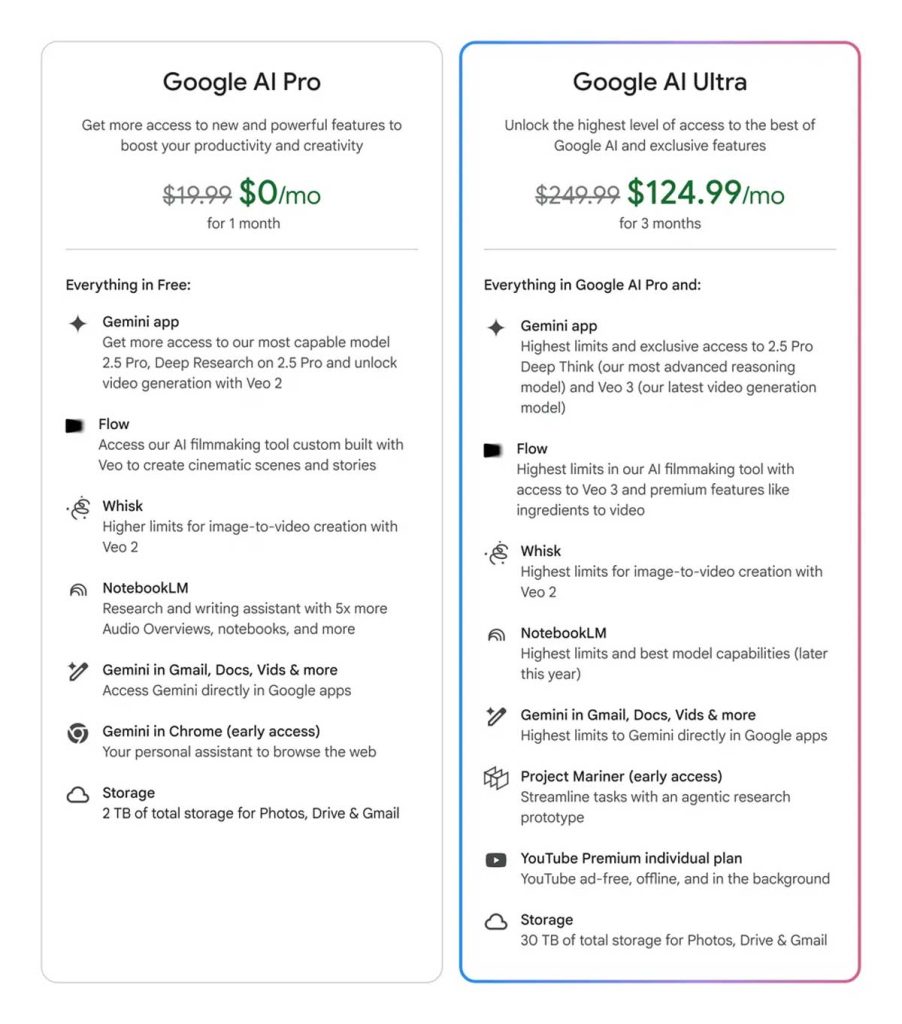
This plan, launched at Google I/O 2025, gives access to advanced AI tools, including Veo 3, through two main platforms:
- The Gemini app: An intuitive interface where you enter a text prompt to generate videos in a few clicks.
- Flow: A tool dedicated to filmmakers, designed to create short films with precise control over characters, scenes, and styles.
Developers and businesses can also leverage Veo 3 via Google Cloud’s Vertex AI, with options to customize duration (5 to 8 seconds), resolution, and even apply safety filters to limit the generation of sensitive content.
Who Is Veo 3 For?
Whether you are a content creator, filmmaker, or professional seeking innovation, Veo 3 has something to offer.
Here are some practical use cases:
Video, meet audio. 🎥🤝🔊
— Google DeepMind (@GoogleDeepMind) May 20, 2025
With Veo 3, our new state-of-the-art generative video model, you can add soundtracks to clips you make.
Create talking characters, include sound effects, and more while developing videos in a range of cinematic styles. 🧵 pic.twitter.com/5Hfpetfg8b
Personalized content creation: Transform your ideas into memes, humorous clips, or personal videos with a unique touch, such as a dialogue between fictional characters.
Rapid prototyping: Visualize product concepts or storyboards in seconds, ideal for breaking creative blocks.
Cinema and storytelling: With Flow, you can produce immersive short films, integrating realistic sounds, without needing a post-production team.
Google has collaborated with filmmakers to refine Flow, ensuring the tool meets the needs of professional creators while remaining accessible to beginners.
Limitations and Outlook
Despite its advances, Veo 3 has some constraints. Videos are limited to 8 seconds, which may restrict certain applications. Additionally, the vertical 9:16 format, popular for social media, is not yet supported. Finally, access is currently limited to the United States, and the high cost of the AI Ultra plan may deter casual users.
However, Google seems determined to democratize its AI tools. In the future, we can hope for broader availability and additional features, such as longer videos or varied formats.
Why Veo 3 Is a Game Changer
By integrating audio into video generation, Veo 3 redefines what AI can accomplish. It is no longer just about creating animated images, but about producing multisensory experiences. Compared to competitors like OpenAI’s Sora, Veo 3 stands out for its ability to generate native sounds, offering an all-in-one solution for creators.
If you are passionate about video creation or curious to discover the possibilities of AI, Veo 3 deserves your attention. Although its access is still exclusive, it heralds a new era for digital content production.
Are You Ready to Try Veo 3?
If you are lucky enough to reside in the United States and subscribe to the AI Ultra plan, dive into the world of Veo 3 via Gemini or Flow. Experiment, create, and share your ideas with the world! To learn more, visit the Google DeepMind website or explore Google Cloud resources.
Stay tuned, because the future of video creation promises to be more exciting than ever!


