

Since the massive democratization of generative artificial intelligences and the constant evolution of language models (LLMs) like GPT-4, Claude, or Gemini, the boundary between human writing and synthetic production is thinning. It is becoming increasingly complex to distinguish a text written by a human expert from content generated in seconds by an AI.
However, despite the rapid technological advances through 2026, algorithms still leave digital fingerprints. Certain stylistic, structural, and factual clues allow trained eyes to spot texts produced by artificial intelligences.
Here is an in-depth analysis of the main signs that reveal AI-written content and methods to detect them.
Frequent repetitions and language tics
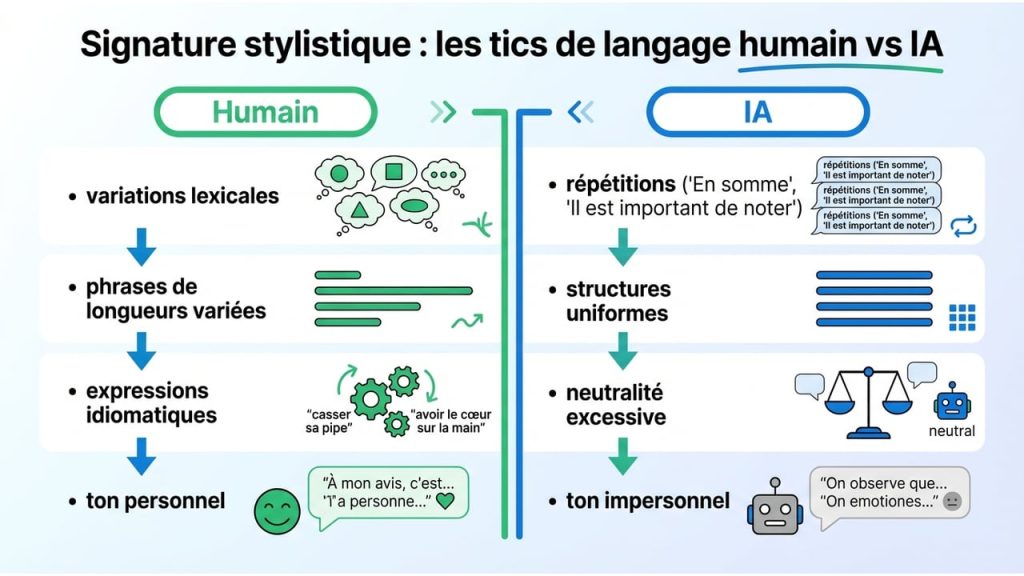
The first distinctive sign, and often the most obvious, lies in redundancy. Language models work on statistical probabilities: they predict the most logical next word. This pushes them to frequently reuse the same connecting terms and sentence structures, creating an echo effect.
Unlike a human writer who naturally seeks to vary vocabulary to maintain reader interest, AI tends to “loop” on words it considers relevant or safe.
AI’s favorite words and structures
In 2026, although models are more sophisticated, certain tics persist. Here is a summary table of the most common markers:
| Lexical repetitions (Keywords) | Structural repetitions (Typical phrases) |
|---|---|
| In summary / In conclusion Landscape (digital, current) Essential / Crucial Unlock the potential Navigate through… Tapestry Dive into… allows also furthermore proves to be significant navigate explore | It is important to note that… This article aims to… Not only… but also… By following these steps, you will be able to… In an ever-changing world… It should be emphasized… It is important to… This allows… One can also… plays a crucial / important role is gaining popularity this article examines… by following these tips… |
If you spot an abnormal density of these expressions, or a sentence structure that recurs in every paragraph (Subject + Verb + Complement, without variation), the probability of artificial origin is very high. These words, while correct, are statistically over-represented in AI training corpora compared to everyday language.
To go further on optimizing this content, you can check out a complete list and techniques in this article on how to make AI more human.
A lack of “Perplexity” and “Burstiness” (Creativity)
AI detection experts use two key concepts to analyze style: perplexity and burstiness. Texts generated by AIs often score low in both areas.
Perplexity measures text complexity. AI, seeking to minimize errors, produces very predictable and smooth sentences. “Burstiness” measures variation in sentence structure. A human will alternate short, punchy sentences with long, complex ones. AI tends toward rhythmic monotony.
An excessively neutral and consensual tone
Artificial intelligences like ChatGPT are programmed to be helpful and harmless. This translates into:
- A refusal to take a stance: AI often uses the conditional tense or phrases like “it is generally accepted that” to avoid giving a definitive opinion.
- A lack of emotion: Humor, sarcasm, irony, or anger are very difficult to simulate convincingly. The text appears “flat.”
- An absence of personal anecdotes: Unless explicitly asked to invent a story, AI will not share real-life experiences, making the text impersonal.
Superficial information on technical subjects
When an AI is questioned about a very specific niche or breaking news, its limitations quickly appear. It can generate grammatically perfect but meaningless text, a phenomenon sometimes called “competence hallucination.”
It will tend to stay on the surface, providing generalities where a human expert would bring nuances, special cases, or concrete feedback.
Signs of superficiality
- Absence of recent numerical data: AI often avoids precise figures if they are not massively present in its training data.
- Circular explanations: It rephrases the same idea three different ways to fill the void.
- Context omission: It can explain “how” to do something, but forget to explain “why” or “when” not to do it.
Factual inconsistencies and hallucination rates
Despite improvements, the “hallucination” problem persists in 2026. A recent Stanford study (2025) estimates that the hallucination rate of generative models still oscillates between 3% and 20% depending on the complexity of the subject covered.
AI does not “know” things in the human sense; it completes word sequences. It can therefore assert with complete confidence facts that are entirely wrong.
Common types of hallucinations
- False bibliographic references: Invention of authors, studies, or legal articles that do not exist.
- Imaginary quotes: Attribution of famous phrases to the wrong person.
- Faulty logic: Contradictory statements between the beginning and end of the same paragraph (e.g., saying a product is free, then giving its price two lines later).
Prompt residues and copy-paste errors
It is the human error that most often betrays the machine. The hasty use of ChatGPT or similar tools sometimes leads to integrating the “instruction” or the AI’s polite response directly into the final published content.
These typos are irrefutable proof of unreviewed automatic generation.
Conversational markers to watch for
| User prompt (Instruction) | Raw AI response (Often copied by mistake) |
|---|---|
| Write an article about SEO. | “Here is a complete article about SEO:” |
| Give me a list of tips. | “Of course! Here is a list of relevant tips:” |
| Write a conclusion. | “In conclusion, we can say that…” (sometimes at the beginning of a block) |
| Regenerate the response. | “As an AI language model, I cannot…” |
We also frequently find forgotten generic placeholders like [Insert your name here] or [Date], typical of cover letter templates or mass-generated emails.
Using advanced detection tools (2026 Update)
If manual analysis leaves doubt, using specialized software is the most reliable method. The AI detector market has matured, now offering accuracy rates far superior to the experimental tools of 2023.
Here are the market leaders for verifying content authenticity:
1. GPTZero
Considered the benchmark in 2026, GPTZero claims 99% accuracy on texts entirely generated by AI. It specifically analyzes the perplexity and “burstiness” of text. It is particularly effective at spotting academic or professional texts generated by the latest GPT versions.
2. Lucide.ai (The French-language expert)
For texts in French, Lucide.ai stands out for its ability to understand the nuances of the French language. Where American tools sometimes fail on French syntax, Lucide offers a very high detection rate and details suspicious sentences.
3. Originality.ai
Very popular among website publishers and marketing professionals, Originality.ai displays accuracy ranging between 76% and 94%. It is capable of detecting not only ChatGPT but also content paraphrased by tools like Quillbot.
4. Copyleaks
An enterprise-level solution, Copyleaks is used by universities and large corporations. It offers sentence-by-sentence analysis and detects blends (hybrid human/AI text).
Beware of false positives: It is important to note that no tool is infallible. A text written by a human with a very formal and academic style can sometimes be flagged as “AI.” The ideal approach is to combine tool analysis with critical human review, looking for the repetitions and lack of depth mentioned above.


