

B Corp certification is increasingly popular among companies concerned about their environmental and social impact.
This demanding label holistically evaluates organizational practices, with a particular emphasis on ecological performance.
In this context, carbon accounting is an essential tool for companies aspiring to join the B Corp movement.
Carbon accounting meets B Corp certification environmental requirements

Environmental criteria requiring precise emissions measurement
To obtain B Corp certification, demonstrate your commitment to the environment in a tangible and measurable way. Carbon accounting provides the essential quantitative data needed to assess your organization’s climate impact.
It allows you to precisely quantify the greenhouse gas emissions generated by all activities, thus providing a solid basis for the B Corp assessment.
The carbon footprint as a prerequisite for demonstrating environmental impact
Completing a comprehensive carbon footprint is a fundamental step in the B Corp certification process. This approach involves methodically quantifying your company’s direct and indirect emissions, covering its entire value chain.
The carbon footprint highlights the main emission sources and identifies priority action levers to reduce the environmental footprint.
Scope 1, 2, and 3 traceability to meet B Corp standards
B Corp standards require an in-depth analysis of emissions according to the three scopes defined by the GHG Protocol:
- Scope 1: direct emissions from the company’s own activities
- Scope 2: indirect emissions associated with energy consumption
- Scope 3: other indirect emissions upstream and downstream of the value chain
Carbon accounting allows you to precisely map these different perimeters, offering a comprehensive view of the organization’s climate impact. This detailed traceability meets B Corp’s high expectations regarding environmental transparency and commitment.
Carbon accounting tools facilitate obtaining and maintaining certification
Automated environmental data collection
Modern carbon accounting solutions, such as those offered by Greenly, greatly simplify the collection and analysis of data needed for the B Corp assessment. These tools automate the retrieval of information from multiple sources: energy bills, transportation data, purchases, etc.
This automation considerably reduces the time and effort required to compile a comprehensive carbon footprint, while minimizing the risk of errors.
Standardized reporting compliant with B Corp requirements
Carbon accounting platforms generally integrate reporting features aligned with international standards, including those used by B Corp. These tools automatically generate detailed reports presenting emissions by scope, by activity, and by operational unit.
This standardized format greatly facilitates the assessment of environmental performance by B Corp auditors, thereby accelerating the certification process.
Continuous performance tracking for recertifications
B Corp certification is not a permanent achievement: renew it every three years to keep your label. Carbon accounting tools enable real-time emissions tracking, facilitating regular updates to the carbon footprint.
This dynamic approach helps you demonstrate your ongoing progress in reducing impact, a key criterion for B Corp recertifications.
| Feature | Benefit for B Corp Certification |
|---|---|
| Automated data collection | Time savings and better reliability |
| Standardized reporting | Compliance with B Corp requirements |
| Real-time tracking | Easier recertifications |
Practical strategies for integrating carbon accounting and the B Corp approach
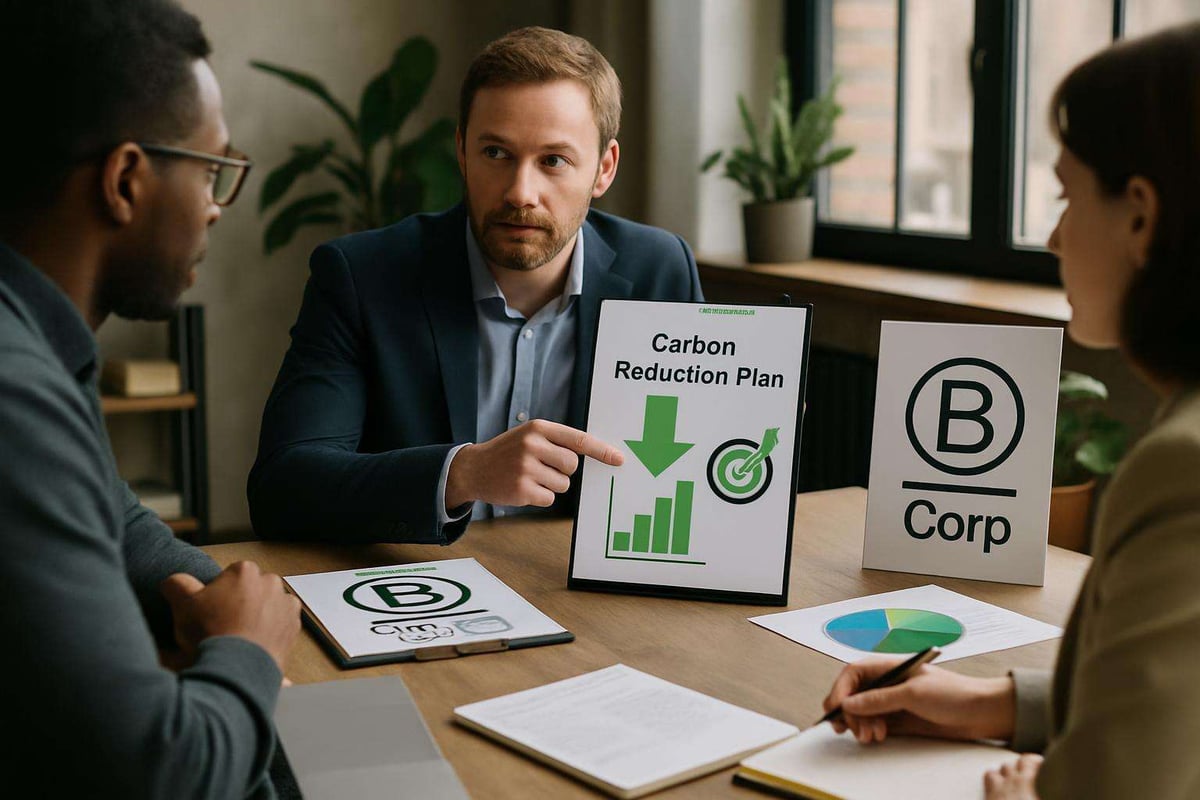
Define an emissions reduction plan aligned with B Corp objectives
To maximize your chances of obtaining B Corp certification, develop a concrete action plan aimed at reducing your company’s carbon footprint. This plan should be based on the carbon footprint results to target the most significant emission sources.
Set quantified reduction targets, aligned with scientific recommendations (Science-Based Targets) and consistent with B Corp standards. Identify priority actions to implement, whether it involves energy optimization, sustainable mobility, or product eco-design.
Involve stakeholders in the environmental approach
B Corp certification values collaborative and inclusive approaches. Mobilize all your company’s stakeholders around your carbon accounting initiative:
- Train employees on climate issues and the use of carbon measurement tools
- Engage suppliers in a transparency approach regarding their own emissions
- Raise customer awareness about the carbon impact of products and services
This participative approach strengthens the organization’s overall commitment to B Corp values, while facilitating data collection for the carbon footprint.
Communicate transparently about carbon results
Transparency is a fundamental pillar of the B Corp philosophy. Adopt open and regular communication about your carbon performance:
Publish your detailed carbon footprint annually, explaining the methodology used and the observed trends. Share your reduction targets and the progress achieved, without hiding the difficulties encountered.
| Communication Element | Recommended Content |
|---|---|
| Annual report | Complete carbon footprint, trend analysis |
| Website | Reduction targets, implemented actions |
| Social media | News on low-carbon initiatives |
This transparency demonstrates your sincere commitment to B Corp principles and strengthens the credibility of your environmental approach with evaluators.


