

Grok 3, the latest version of xAI’s AI model, promises to revolutionize the field of artificial intelligence.
With its advanced reasoning capabilities, real-time search, and multimodal features, Grok 3 positions itself as a serious competitor against industry giants such as OpenAI and DeepSeek.
DeepSearch Mode for Real-Time Search
Accessing Fresh and Relevant Information
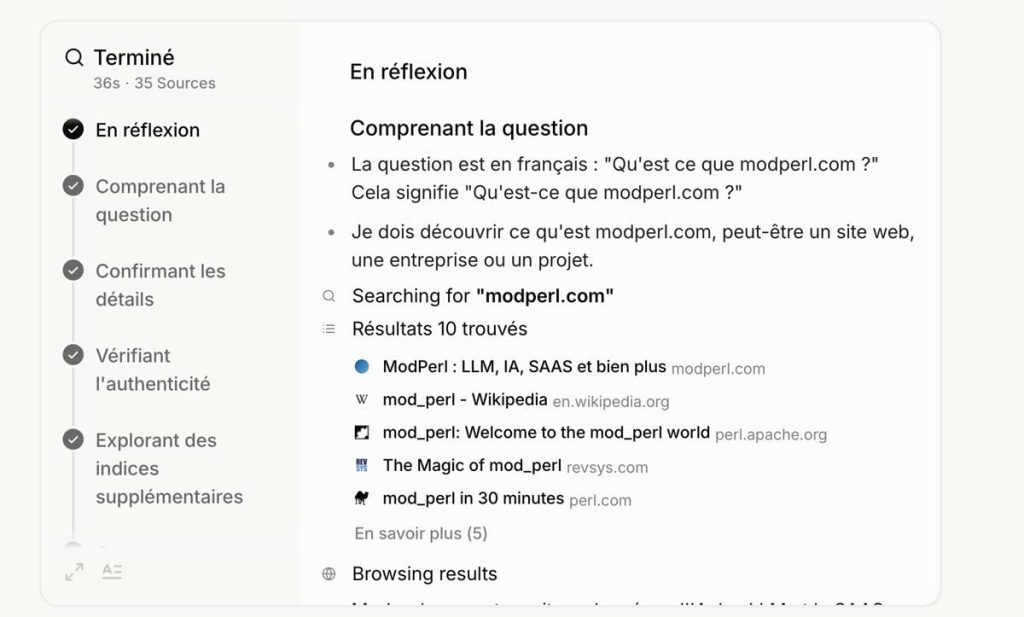
Grok 3’s DeepSearch mode allows performing real-time web searches. Unlike traditional AI models that rely on pre-trained data, DeepSearch leverages the most recent information available online.
This feature is particularly useful for following news, analyzing market trends, or conducting in-depth technical research.
In this example, Grok understood that it needed to visit different pages of the modperl.com website to understand what it was about. It ultimately responded very well. I also tested with ChatGPT’s Search mode, which also responded well. Claude 3.7 Sonnet, not having a search mode, failed the test.
Synthesis and Source Verification
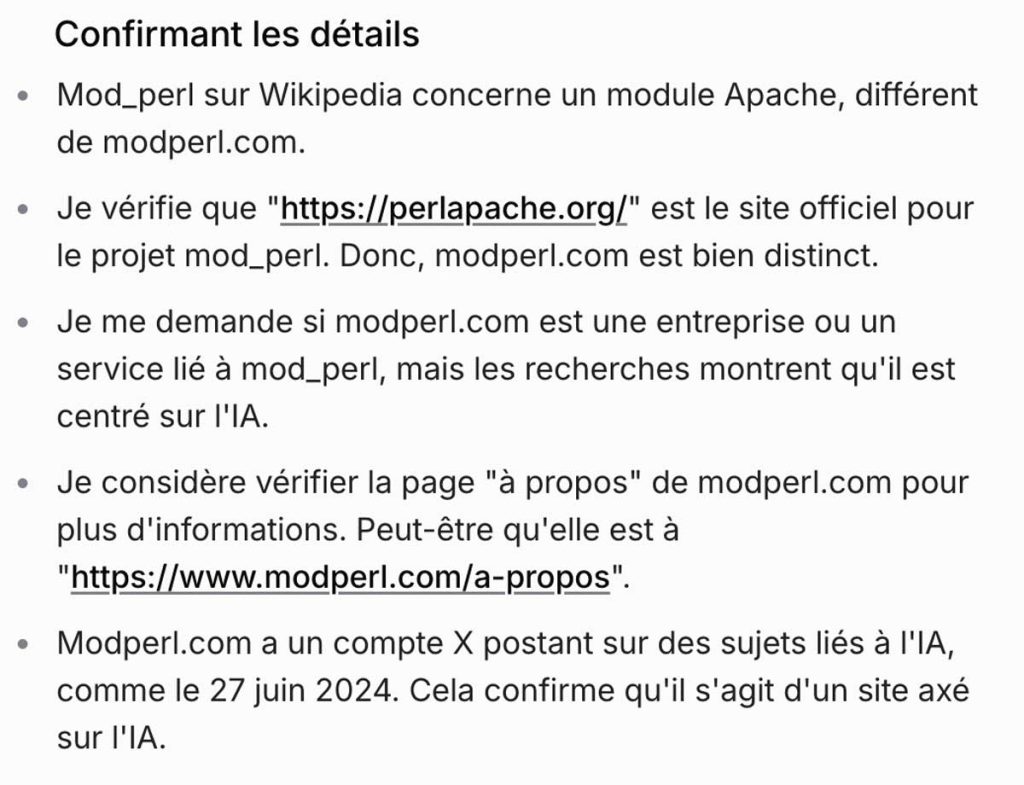
Not content with just browsing the web, DeepSearch synthesizes collected information and verifies source reliability before generating a response. This process ensures accurate and factual results, thus eliminating the risk of spreading false information or outdated data.
Here are some examples of queries where DeepSearch excels:
- What are the latest advances in cancer research?
- How did financial markets react to the merger announcement between companies X and Y?
- What are the weather forecasts for next week in my area?
Advanced Reasoning Capabilities of Think Mode
Breaking Down Complex Problems
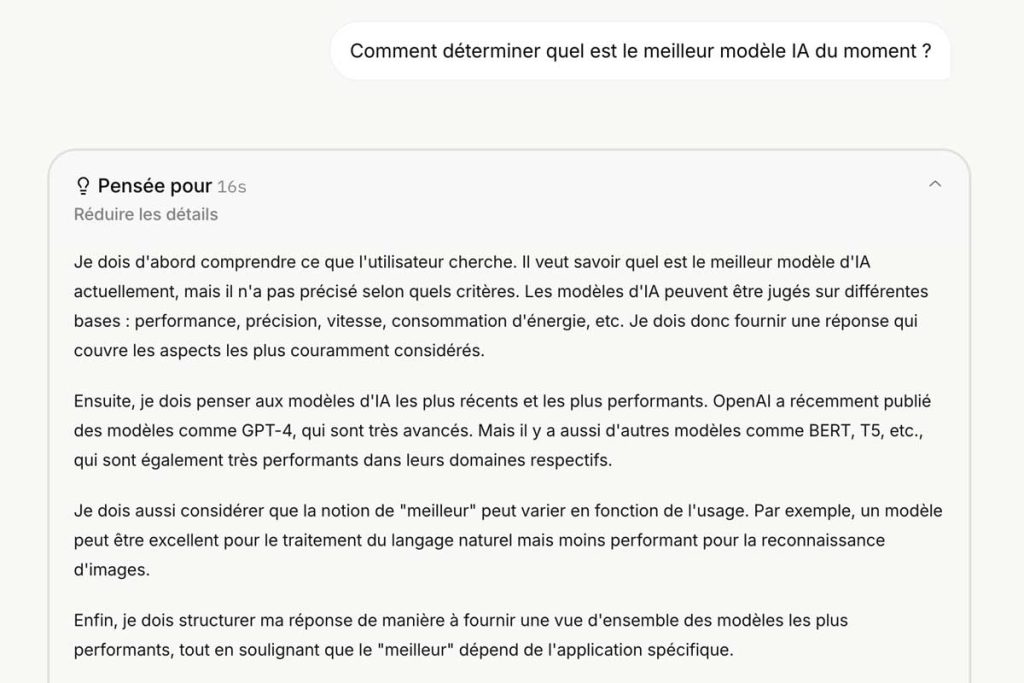
Grok 3’s Think mode activates a multi-step reasoning process. Instead of providing an immediate answer, the AI breaks complex problems into simpler sub-problems.
It then explores different solution paths, evaluates their relevance, and progressively refines its answer until achieving an optimal result.
Mimicking Human Structured Thinking
By adopting an approach similar to that of a human expert, Think mode makes the resolution process transparent and understandable. This approach is particularly useful in fields such as mathematics, programming, or logic.
Multimodal Text and Image Features
Image and Video Processing
Grok 3 is not limited to text processing. Thanks to its multimodal capabilities, it can also analyze images and videos. Whether for detecting objects, recognizing faces, or extracting visual information, Grok 3 offers cutting-edge performance.
Image Generation from Text Descriptions
But Grok 3’s achievements do not stop there. The model is capable of generating images from text descriptions. You can thus obtain illustrations, graphics, or even original artworks by simply describing what you want to see.

Some examples of multimodal queries:
- Analyze the content of this image and describe what you see.
- Generate an illustration depicting a sunset on a tropical beach.
Code Generation Test
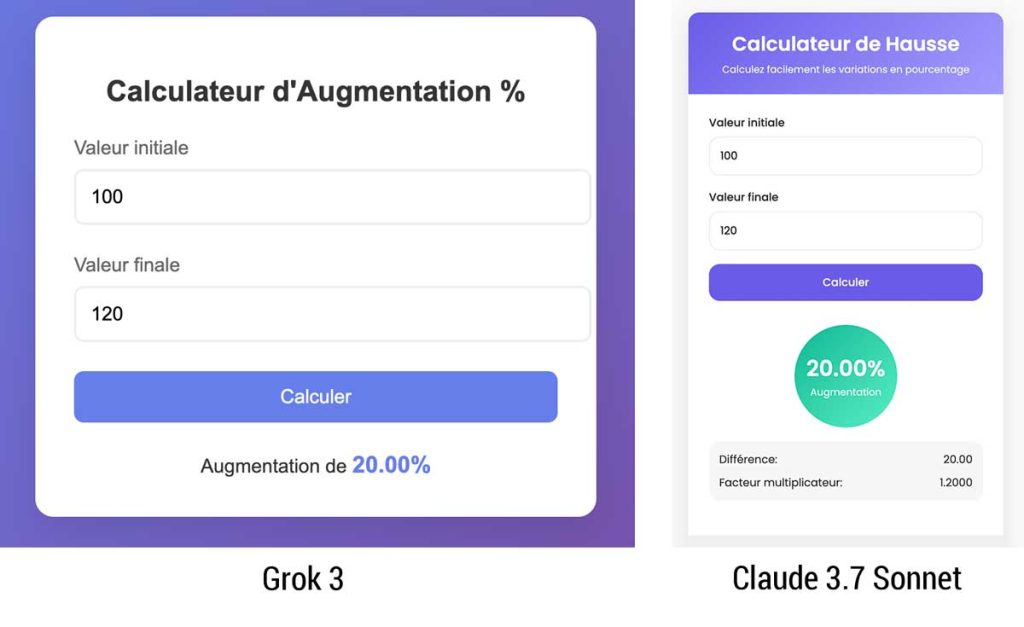
We had seen that certain models like Claude 3.7 Sonnet were particularly good at code generation, especially in terms of design. Grok is OK at this level but nothing more.
Technical Characteristics of the Grok 3 Model
An Extraordinary Context Window
One of Grok 3’s most notable characteristics is its context window, which probably reaches 1,000,000 tokens, according to xAI’s official blog published on February 18, 2025.
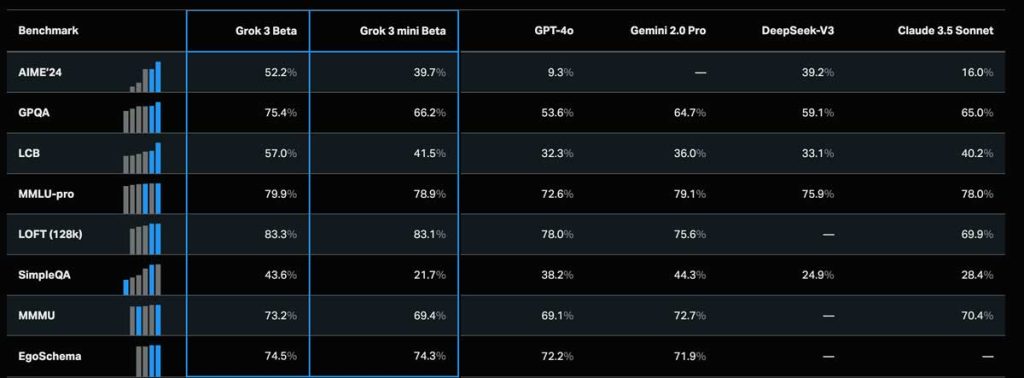
This means Grok 3 can analyze and understand massive amounts of text at once! This capability is confirmed by its exceptional performance on the LOFT (128k) benchmark, where it excels in 12 varied tasks.
Impressive Performance
Grok 3 does not just have a large memory; it is also incredibly performant. Here are some numbers that speak for themselves:
- AIME 2025 (mathematics): 93.3% – a score that demonstrates its power in mathematical reasoning.
- GPQA (expert reasoning): 84.6% – perfect for complex tasks.
- LiveCodeBench (coding): 79.4% – ideal for developers.
- Chatbot Arena (Elo): 1402 – a reference in conversation.
But that is not all. Grok 3 also shines with its multimodal capabilities, able to process text, images, and videos.
On the MMMU benchmark (image comprehension), it achieves 73.2%, and on EgoSchema (video comprehension), 74.5%. These scores often place it ahead of competitors like GPT-4o or Gemini 2.0 Pro, an unexpected feat that underscores xAI’s ambition in this domain.
The Different Grok API Models and Their Pricing
xAI offers several Grok 3 variants adapted to different use cases. Whether you are a developer, researcher, or simply curious to experiment with AI, there is a model tailored to your needs.
| Model | Input Context | Text Input | Image Input | Text Completion |
|---|---|---|---|---|
| grok-3-beta | 131072 | $3.00 | – | $15.00 |
| grok-3-mini-beta | 131072 | $0.30 | – | $0.50 |
| grok-3-fast-beta | 131072 | $5.00 | $25.00 | |
| grok-3-mini-beta | 131072 | $0.30 | $0.50 | |
| grok-2-vision-1212 | 32768 | $2.00 | $2.00 | $10.00 |
| grok-2-1212 | 131072 | $2.00 | – | $10.00 |
| grok-vision-beta | 8192 | $5.00 | $5.00 | $15.00 |
| grok-beta | 131072 | $5.00 | – | $15.00 |
This is the grid xAI published when Grok 3 came out, in 2025, and the article keeps it because it covers that generation. The -beta identifiers have since given way to stable versions, and xAI’s current catalogue no longer lists Grok 3: up-to-date models and prices are on the official xAI models page.
Note that current models have knowledge up to November 17, 2024.
05/22/2025: Grok’s live search API is available for free, with a beta until June 5.
The Free Version of Grok 3 and SuperGrok Mode
Since February 2025, Grok 3 is free on X for a limited time. You already get many features, so why pay $30 per month for SuperGrok?
The free version
- 10 messages and 10 images every 2 hours (with watermark).
- “Think” and DeepSearch modes limited to 2 queries per day each.
- Maximum 3 image analyses per day.
That is enough for light use, but the limits become frustrating quickly.
What SuperGrok offers at $30 per month
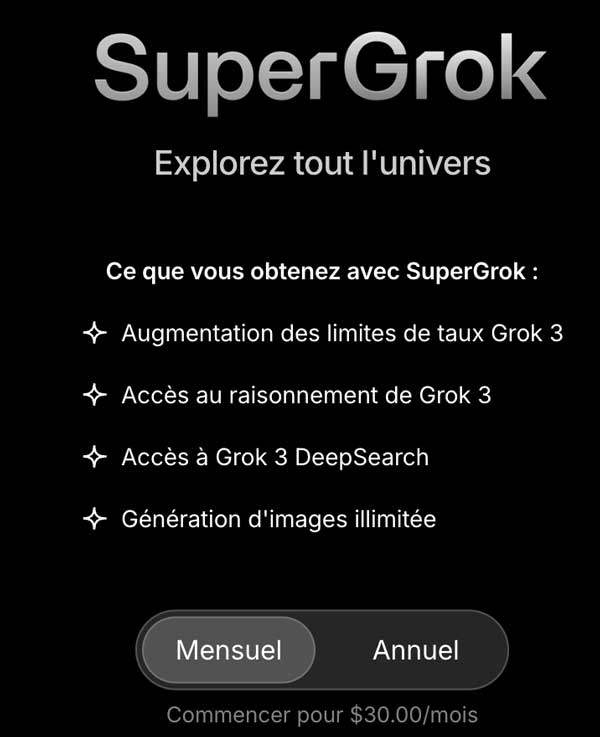
- No limits: unlimited messages and images.
- Reasoning (“think”, “big brain”) and DeepSearch without restrictions.
- Priority access and exclusives like the upcoming voice mode.


