
Claude Sonnet 3.5, the latest version of Anthropic’s generative AI model, brings its share of new features and improvements.
With better performance, new features, and even simpler integration, this update promises to revolutionize the user experience and open new perspectives for businesses.
What’s new in Claude Sonnet 3.5
Claude Sonnet 3.5 stands out with its advanced capabilities in natural language processing and content generation.
Thanks to a better understanding of nuances, humor, and complex instructions, this model produces high-quality content with a natural and relevant tone.
Execution speed has also been improved, with Claude Sonnet 3.5 running twice as fast as its predecessor, Claude Opus 3.
This optimization makes it particularly suited for complex tasks like contextual customer support and multi-step workflow orchestration.
Performance comparison of Claude Sonnet 3.5 with its competitors and the previous version

Claude Sonnet 3.5 outperforms competing models, including OpenAI’s flagship model, GPT-4, and Claude Opus 3 across a wide range of evaluations.
It sets new benchmarks for graduate-level reasoning (GPQA), academic knowledge (MMLU), and coding proficiency (HumanEval).
| Model | GPQA | MMLU | HumanEval |
|---|---|---|---|
| Claude Sonnet 3.5 | 90% | 85% | 64% |
| Claude Opus 3 | 85% | 80% | 38% |
| GPT-4 | 88% | 82% | 60% |
Is it still worth using Claude Opus 3?
Although Claude Sonnet 3.5 has superior performance, Claude Opus 3 remains a viable option for users with very specific needs. Claude Opus remains, in my opinion, better in terms of instruction following.
However, for applications requiring advanced intelligence and faster execution speed, Claude Sonnet 3.5 is undeniably the most relevant choice.
Concrete use cases for Claude Sonnet 3.5 with Artifacts
The new Artifacts feature transforms how users interact with Claude Sonnet 3.5.
When users request the model to create content such as code snippets, text files, or website mockups, these elements are generated in a special panel, right next to their ongoing conversation.
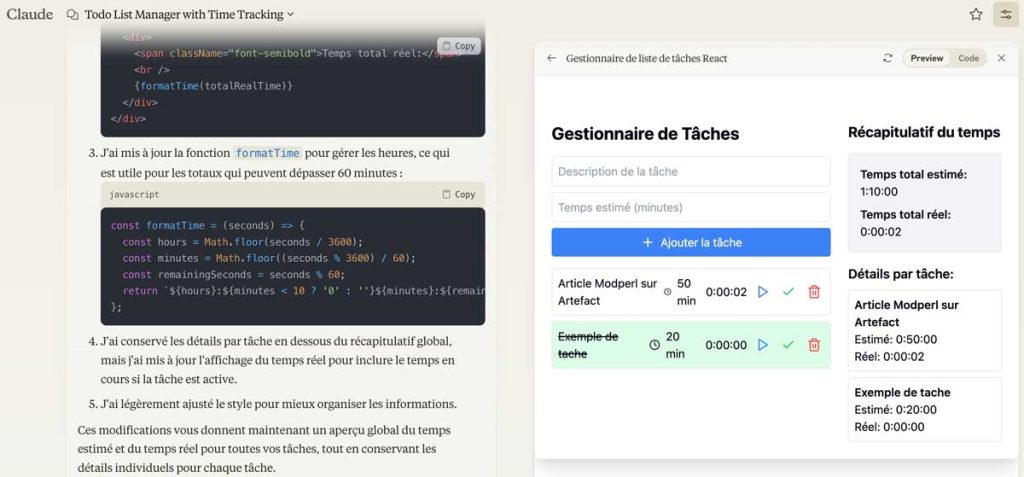
This addition offers an interactive work environment where users can:
- View Claude’s outputs in real-time
- Edit and enrich AI-generated content
- Seamlessly integrate created elements into their projects
Artifacts open new perspectives for many business sectors, such as:
- Web and mobile development
- Marketing content creation
- User interface design
- Technical and scientific writing
Pricing and availability of Claude Sonnet 3.5
Claude Sonnet 3.5 is now accessible through several channels:
| Platform | Availability |
|---|---|
| Claude.ai | Free |
| Claude iOS App | Free |
| Anthropic API | Paid |
| Amazon Bedrock | Paid |
| Google Cloud’s Vertex AI | Paid |
The API pricing is set at $3 per million input tokens and $15 per million output tokens, with a context window capacity of 200,000 tokens.

Subscribers to Claude Pro and Team plans benefit from higher rate limits, allowing them to fully exploit Claude Sonnet 3.5’s potential in their large-scale projects.


