

Anthropic has just unveiled Claude Opus 4.1, the latest version of its cutting-edge artificial intelligence model.
This update brings significant improvements in coding, research, and reasoning compared to its predecessor.
Available now for paying users, Claude Opus 4.1 promises to redefine AI standards for complex tasks.
The main new features of Claude Opus 4.1 compared to the previous version
Better coding performance
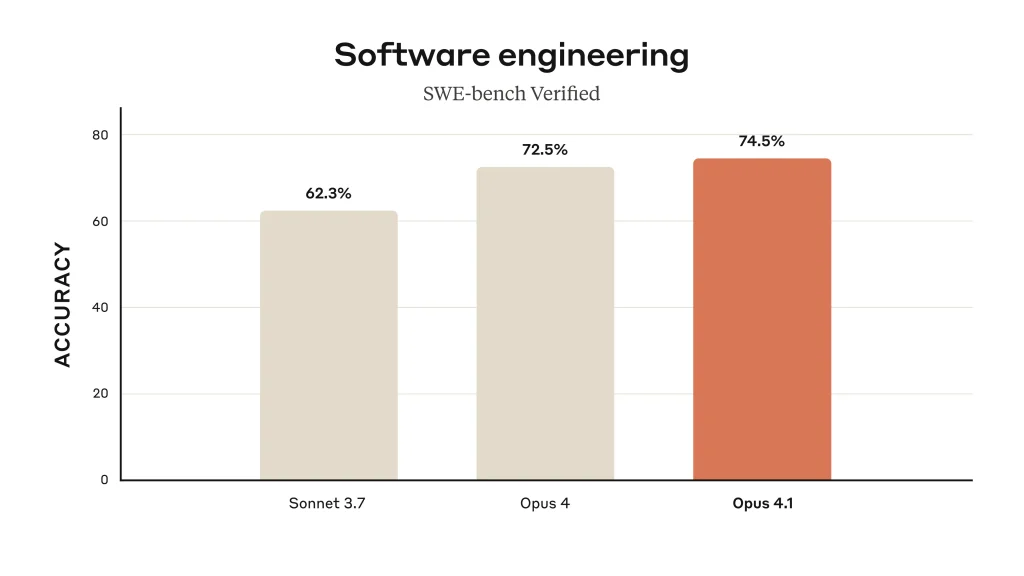
Claude Opus 4.1 reaches a new milestone by achieving 74.5% performance on the SWE-bench Verified benchmark. This notable advancement over the previous version positions the model as a reference for real-world complex coding tasks. Developers can now rely on an even more powerful virtual assistant to help them with their programming projects.
Agentic research capabilities
The model now excels in agentic research and in-depth data analysis. This evolution allows Claude Opus 4.1 to conduct more advanced investigations and process large datasets with superior accuracy. Researchers and analysts will greatly benefit from these new capabilities for their data exploration and interpretation work.
Optimized detail tracking
One of the major advances of Claude Opus 4.1 concerns its ability to track details with great precision. This characteristic is particularly useful for tasks requiring meticulous attention, such as legal document analysis or source code review. The model can now efficiently identify and process nuances and critical information within large volumes of data.
Optimized multi-file refactoring
Developers will particularly appreciate the progress made in multi-file refactoring. Claude Opus 4.1 demonstrates a superior ability to restructure and optimize code across multiple files simultaneously, while preserving the project’s consistency and functionality. This advanced feature greatly facilitates the maintenance and improvement of complex codebases. For a detailed analysis of Claude Opus features, developers can consult specialized resources.
Significant performance gains
According to evaluations, Claude Opus 4.1 shows performance gains equivalent to the jump observed between Sonnet 3.7 and Sonnet 4. This substantial progression demonstrates Anthropic’s continuous efforts to push the boundaries of artificial intelligence. Users can expect an overall performance improvement across a wide range of tasks, from text generation to complex problem-solving.
Technical characteristics and advanced capabilities of the model
Architecture and intelligence for complex tasks
Claude Opus 4.1 relies on an advanced neural architecture specifically designed to excel in complex tasks. This infrastructure allows the model to process multi-dimensional problems with remarkable efficiency. Whether for scientific data analysis or creative content generation, this version demonstrates impressive versatility and depth of reasoning.
Precision programming and debugging
Claude Opus 4.1 has considerably improved programming capabilities. The model can now:
- Generate complex code with superior precision
- Identify and fix subtle bugs in large codebases
- Propose relevant performance optimizations
- Effectively assist in designing advanced algorithms
These advances make this version a particularly powerful development assistant, capable of tackling high-level programming challenges.
In-depth research and data processing
Claude Opus 4.1 excels in in-depth research and processing of large data volumes. The model can rapidly analyze complex datasets, extract relevant insights, and present synthetic results. This capability is useful for researchers, data analysts, and professionals working on projects requiring extensive exploration of varied information.
Integrations and API compatibility
Anthropic has ensured that Claude Opus 4.1 is easily integrable into various work environments. The model is now available via:
- Anthropic’s API
- Amazon Bedrock
- Google Cloud Vertex AI
- Claude Code (for developers)
This broad compatibility allows businesses and developers to easily integrate the advanced capabilities of this version into their existing workflows and applications.
Performance and comparative benchmarks with the competition
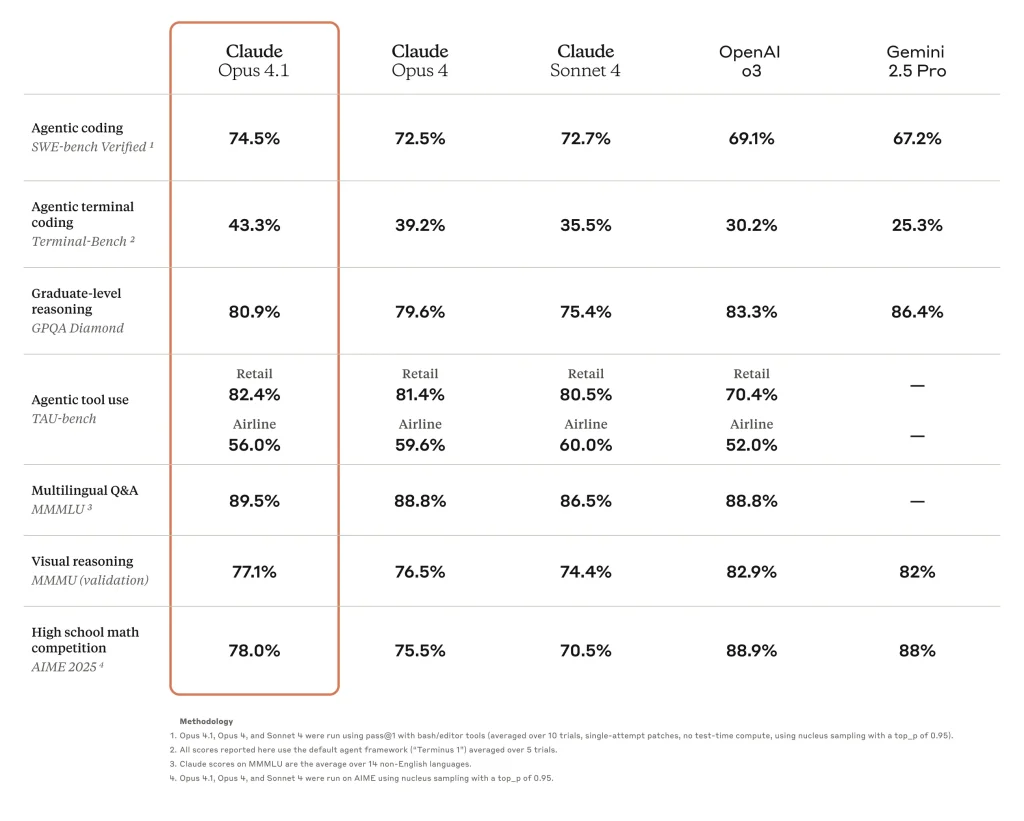
Results on SWE-bench Verified
Claude Opus 4.1 achieved exceptional performance on the SWE-bench Verified benchmark, reaching a score of 74.5%. This result places it at the top of AI models for real-world complex coding tasks. The following table compares Claude Opus 4.1’s performance with other leading models:
| Model | SWE-bench Verified Score |
|---|---|
| Claude Opus 4.1 | 74.5% |
| GPT-4 | 72.8% |
| Claude Opus 4 | 72.5% |
| Gemini Pro | 70.2% |
Partner evaluations
Several Anthropic partners have evaluated Claude Opus 4.1’s performance under real-world usage conditions. GitHub noted significant advances in multi-file refactoring, while Rakuten Group highlighted the model’s superior accuracy in identifying and fixing bugs in large codebases. Windsurf reported a one standard deviation improvement on its junior developer benchmark compared to Opus 4.
Comparison with competing models
Claude Opus 4.1 stands out from its competitors on several key aspects. The table below presents a performance comparison across different tasks:
| Task | Claude Opus 4.1 | GPT-4 | Gemini Pro |
|---|---|---|---|
| Complex coding | Excellent | Very good | Good |
| Agentic research | Excellent | Good | Very good |
| Data analysis | Excellent | Very good | Very good |
| Logical reasoning | Excellent | Excellent | Very good |
Improvement on development benchmarks
Claude Opus 4.1 demonstrated a one standard deviation improvement on development benchmarks compared to its predecessor. This significant progression demonstrates the advances made by Anthropic in optimizing its model for programming tasks. Developers can expect more performant and precise assistance in their coding projects, whether for web development, mobile applications, or complex software.
Pricing structure and model access options
API pricing and costs per million tokens
Anthropic has established a competitive pricing structure for Claude Opus 4.1. The costs per million tokens are as follows:
- Input: $15 per million tokens
- Output: $75 per million tokens
- Prompt caching (write): $18.75 per million tokens
- Prompt caching (read): $1.50 per million tokens
This pricing allows businesses and developers to use Claude Opus 4.1’s advanced capabilities in a flexible manner adapted to their specific needs.
As a reminder, here are the prices of the main AI models:
| Model | Input Price | Output Price |
|---|---|---|
| GPT-4.1 | $2.00 | $8.00 |
| GPT-4.1 mini | $0.40 | $1.60 |
| GPT-4.1 nano | $0.10 | $0.40 |
| OpenAI o3 | $2.00 | $8.00 |
| o4-mini | $1.10 | $4.40 |
| GPT-4o | $2.50 | $10.00 |
| GPT-4o mini | $0.15 | $0.60 |
| GPT-4.5 (Orion) | $75.00 | $150.00 |
| OpenAI o1 | $15.00 | $60.00 |
| OpenAI o1-pro | $150.00 | $600.00 |
| Claude 4.1 Opus | $15.00 | $75.00 |
| Claude 4 Sonnet | $3.00 | $15.00 |
| Claude 3.7 Sonnet | $3.00 | $15.00 |
| Claude 3.5 Haiku | $0.80 | $4.00 |
| Grok-4 | $3.00 | $15.00 |
| Grok-3 | $3.00 | $15.00 |
| Grok-3 Mini | $0.30 | $0.50 |
| Grok-3 Fast | $5.00 | $25.00 |
| Grok-3 Mini Fast | $0.60 | $4.00 |
| DeepSeek-R1 | $0.55 | $2.19 |
Access platforms
Claude Opus 4.1 is accessible via several platforms, offering great usage flexibility:
- Claude Code (for developers)
- Amazon Bedrock
- Google Cloud Vertex AI
- Anthropic API
This diversity of access points facilitates the integration of the model into different work environments and existing workflows.
Access for users and developers
Claude Opus 4.1 is available for paying Claude users and developers via Claude Code. This approach ensures privileged access to the model’s advanced features for professionals and businesses who need them most. Developers benefit from specific tools to fully leverage Claude Opus 4.1’s capabilities in their projects.
Pricing comparison with other Anthropic models
While Claude Opus 4.1 is Anthropic’s most advanced model, the company also offers other pricing options to meet various needs and budgets. For a detailed comparison of Claude AI pricing, users can consult specialized resources. The table below presents an overview of pricing for the different models:
| Model | Input ($/MTok) | Output ($/MTok) |
|---|---|---|
| Claude Opus 4.1 | 15 | 75 |
| Claude Sonnet 4 | 3 | 15 |
| Claude Haiku 3.5 | 0.80 | 4 |
This tiered pricing structure allows users to choose the model best suited to their needs and budget, while benefiting from Anthropic’s technological advances in the field of AI.


