
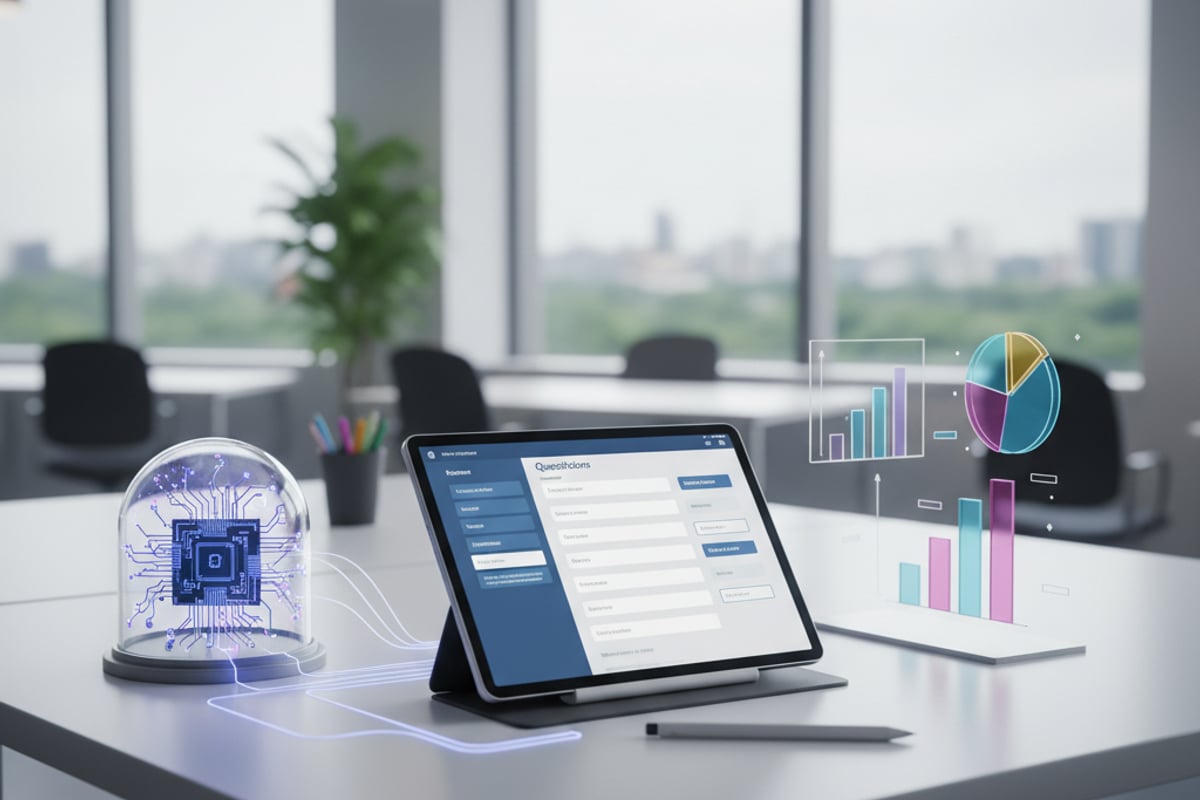
Creating professional questionnaires has long been a time-consuming challenge for businesses and training organizations.
Drag’n Survey, a French SaaS platform specializing in online surveys, is radically transforming this reality through the integration of generative artificial intelligence agents.
Where it previously took juggling 47 tabs for 3 hours to design a survey, the solution now allows generating a complete questionnaire in 2 minutes.
This technological revolution relies on three specialized AI agents that cover the entire lifecycle of a questionnaire, from its design to the analysis of results.
The 3 AI agents of Drag’n Survey to automate your questionnaires from A to Z

The AI agent ecosystem developed by Drag’n Survey relies on a modular architecture where each agent focuses on a specific phase of the process.
This specialization ensures natural and high-performing interaction at each stage, from initial generation to the exploitation of collected data.
Multimodal Creation Agent: generate a complete questionnaire in 2 minutes from a document
The multimodal creation agent is the entry point of the AI ecosystem.
It accepts an impressive variety of sources: PDF files, Word documents, PowerPoint presentations, images, website URLs, and simple text instructions.
This versatility allows users to start from existing materials rather than starting from scratch.
The operation relies on an intelligent dialogue with the user to precisely understand their needs.
The agent analyzes the provided documents, extracts key themes, and automatically generates an optimized questionnaire structure.
The technical capabilities of this agent include several advanced features:
- Simultaneous upload of multiple files in different formats (PDF, Word, PPT, images, TXT, code files)
- Direct web page analysis via URL to extract relevant content
- Integrated Internet search to automatically enrich the questionnaire with contextual data
- Referencing existing questionnaires as a base template
- Automatic generation of conditional branching and scoring systems
This multimodal approach eliminates the need to manually enter each question.
On dragnsurvey.com, the platform highlights this ability to transform any document into a structured survey, with varied question types (multiple choice, open-ended questions, rating scales).
To maximize the agent’s effectiveness, mastering the art of prompting allows obtaining even more precise results tailored to your business context.
| Input source | Processing type | Generated result | Average time |
|---|---|---|---|
| PDF document | Text and structure extraction | Questionnaire with thematic questions | 2 minutes |
| Website URL | Online content analysis | Product satisfaction survey | 2 minutes |
| PowerPoint presentation | Slide and concept extraction | Training quiz with scoring | 2 minutes |
| Text instructions | Context understanding | Personalized survey | 1-2 minutes |
Conversational Editing Agent: optimize and personalize your questions intuitively
Once the questionnaire is generated, the conversational editing agent takes over to refine and personalize the survey.
This natural language interface eliminates the need to navigate complex menus: users simply formulate their requests, and the agent executes the modifications.
The accepted commands cover a broad spectrum of actions:
- “Add a dropdown question listing the departments of Normandy in first position”
- “Remove question numbering”
- “Add a page break between question 1 and 2”
- “Merge pages 2 and 3”
- “Add scoring to evaluate participants in my training”
- “Set conditional branching based on the respondent’s profile”
The major advantage of this agent lies in its ability to perform complex actions that were previously difficult to execute manually.
For example, creating dynamic lists (all departments in a region, all cities in France) or merging multiple pages while preserving conditional branching logic.
This conversational approach drastically reduces the platform’s learning curve.
Users without technical training can modify sophisticated questionnaires by naturally dialoguing with the AI, just as they would with a human assistant.
Results Analysis Agent: instantly identify trends and sentiments in your responses
The analysis agent transforms the exploitation of collected data into an interactive dialogue.
Rather than manipulating complex Excel spreadsheets, users ask questions in natural language and get personalized insights without prior statistical expertise.
The supported query types illustrate the power of this agent:
- “I’m in the SaaS software sector, what do you think of my NPS?”
- “What are the important elements that emerge from the responses?”
- “What trends are emerging?”
- “What are the possible areas for improvement?”
- “Pull out specific data about dissatisfied users”
The technical operation relies on executing Python code in the background to calculate averages, aggregate data, and produce reliable statistics.
This approach ensures that results are not mere reformulations, but genuine mathematical analyses.
The agent also integrates a data pre-filtering system: users can create a report with specific filters (for example, only users with an NPS below 6) then dialogue with this filtered data for targeted analyses.
| Analysis type | Traditional method | With AI agent | Time savings |
|---|---|---|---|
| NPS calculation | Excel export + manual formulas | Natural language question | 95% |
| Sentiment analysis | Manual reading of open-ended responses | Automatic keyword cloud | 90% |
| Respondent segmentation | Complex Excel filters | Conversational command | 85% |
| Trend identification | Manual charts | Instant AI summary | 92% |
The concrete benefits of AI for your online surveys

The integration of AI agents in Drag’n Survey generates measurable benefits that transform how organizations design and leverage their surveys.
These advantages manifest at three levels: productivity, insight quality, and questionnaire relevance.
A 90% time savings in creating your questionnaires
The reduction in creation time is the most immediately noticeable benefit.
According to official Drag’n Survey communications dated December 2025, the platform allows going from 3 hours of manual work in 2015 to just 2 minutes with AI in 2025.
This 90% acceleration is not limited to initial generation: it extends to the entire process, including modifications, personalization, and formatting.
Traditionally time-consuming steps are now automated:
- Question writing: AI generates clear and unbiased formulations
- Logical structuring: conditional branching is created automatically
- Visual personalization: templates are applied in one click
- Consistency testing: AI detects inconsistencies in questionnaire logic
For training organizations, this speed allows creating assessments compliant with Datadock requirements in minutes rather than hours.
Marketers can launch customer satisfaction surveys in immediate reaction to an event or campaign.
The platform claims over 100,000 questionnaires created annually, demonstrating the massive adoption of these AI features by users.
Actionable insights through predictive analysis and keyword clouds
Results analysis benefits from artificial intelligence tools that transform large volumes of responses into actionable insights.
The general keyword cloud allows instantly identifying recurring themes in open-ended responses, without tedious manual reading.
Drag’n Survey’s AI goes beyond simple visualization by offering sophisticated sentiment analysis.
The system automatically identifies satisfaction levels and extracts key keywords by satisfaction index (positive, negative, neutral).
This automatic segmentation allows understanding not only what respondents think, but also why they are satisfied or dissatisfied.
Teams can thus prioritize corrective actions based on actual impact on satisfaction.
The predictive analysis capabilities rely on models similar to those used by ChatGPT, specifically adapted to the survey context.
The AI can anticipate emerging trends by analyzing the evolution of responses over time, allowing organizations to react proactively rather than retroactively.
Analysis features include:
- Automatic Net Promoter Score (NPS) calculation with sector benchmarking
- Identification of correlations between different questions
- Detection of aberrant or inconsistent responses
- Generation of personalized reports in PDF or Excel format
- Secure sharing of results with password protection
Intelligent personalization adapted to your business sector
Drag’n Survey’s AI integrates contextual understanding that adapts question suggestions to the user’s business sector.
When a marketer creates a customer satisfaction survey, the agent automatically suggests relevant questions for that context (NPS, CSAT, CES).
For a training organization, the AI suggests evaluation questions compliant with quality standards and automatically generates quizzes with scoring adapted to pedagogical objectives.
This personalization extends to the types of questions proposed, recommended measurement scales, and even linguistic formulations.
The AI detects the appropriate tone (formal, informal, technical) based on context and target audience.
Users also benefit from AI-enriched sector templates that integrate best practices from each domain.
These models evolve continuously through machine learning, improving as the platform analyzes more questionnaires and results.
The account supervision feature allows managers to distribute standardized survey templates to their collaborators, while compiling and segmenting results centrally.
This approach ensures methodological consistency while benefiting from AI efficiency.
With subscriptions starting at 25 euros per month for the Basic offer and reaching 99 euros per month for the Premium offer with unlimited AI, the platform offers a 30-day free trial allowing you to test all AI features.
User reviews on platforms like La Fabrique du Net (4.5/5), GetApp France (4.7/5), and Capterra France (4.6/5) highlight the effectiveness of these tools for businesses, marketers, and training organizations.


