

Hallucinations represent one of the most critical challenges for ChatGPT users and large language models (LLMs). This phenomenon occurs when artificial intelligence generates a grammatically correct and plausible response, but one that is factually false or entirely fabricated.
These errors, often stated with disconcerting confidence by the AI, can lead to misleading information, non-existent legal citations, or functional but insecure computer code. For businesses and professionals, this directly compromises the reliability of automated processes.
Fortunately, the evolution of models and the refinement of prompt engineering techniques now make it possible to control this risk. Here are 5 proven and updated techniques for obtaining accurate and reliable results.
Prompting techniques to reduce ChatGPT hallucinations
Formulate clear, specific, and structured prompts
The main cause of hallucinations often lies in the ambiguity of the request. To minimize risks, it is essential to formulate prompts with surgical precision. Instead of asking a vague question like “Tell me about the history of Paris,” which gives too much interpretive freedom to the AI, it is better to structure the request: “Provide a factual summary of the history of Paris between 1900 and 2000, based only on major political events and verified historical sources.”
This method, often called “Persona Prompting” (giving the AI a role, for example “You are an expert historian”), guides the AI toward reliable data rather than improvisation. According to a ZDNET study published in May 2024, adding strict constraints to the prompt reduces hallucinations by an average of 40%. To go further in mastering these instructions and discover advanced structures, it is recommended to consult the complete guide on creating effective prompts, which offers concrete examples for improving the quality of AI interactions.
Provide context and use “Few-Shot Prompting”
Giving ChatGPT additional context or concrete examples (a technique called “Few-Shot Prompting”) anchors the response in a defined reality. Rather than letting the model draw from its vast but sometimes imprecise training base, you provide the reference framework.
For example, starting with “Here is an excerpt from an article about climate change: [text]. Summarize it without adding information not present in this excerpt” limits the AI to the provided data (Grounding). UMA Technology reports in May 2025 that this technique reduces errors by 30 to 50% by forcing the model to act as an information extractor rather than a creative generator. A MIT study, shared on X in June 2025, confirms that contextualized interactions drastically improve the AI’s cognitive precision.
Explicitly request sources and citations
Integrating a traceability requirement into the prompt, such as “Respond by citing reliable and verifiable sources, and indicate the URL or reference document for each claim,” forces the AI to adopt a more rigorous posture. However, be careful: older models could invent sources. With recent web-connected models (like GPT-4o or GPT-5), this technique becomes extremely effective.
Synapse Developpement emphasizes in May 2024 that this method reduces hallucination-related errors by 60%. A test reported by Centaure Marketing reveals that requesting precise references avoided 70% of fabricated responses on complex technical subjects, because the model “checks” its own ability to find the source before responding.
Here is a summary of essential prompting techniques to secure your exchanges:
- Specificity: Ban vague terms and define a role (Persona).
- Grounding: Provide the source text or raw data in the prompt.
- Few-Shot: Give 2 or 3 examples of the expected response (format and tone).
- Citations: Require evidence or verbatim excerpts.
| Technique | Estimated hallucination reduction | Study source |
|---|---|---|
| Clear and specific prompts | 40% | ZDNET (2024) |
| Context and Few-Shot | 30-50% | UMA Technology (2025) |
| Request for verifiable sources | 60% | Synapse Developpement (2024) |
Structured reasoning methods to improve reliability
Use the Chain of Thought (CoT) technique
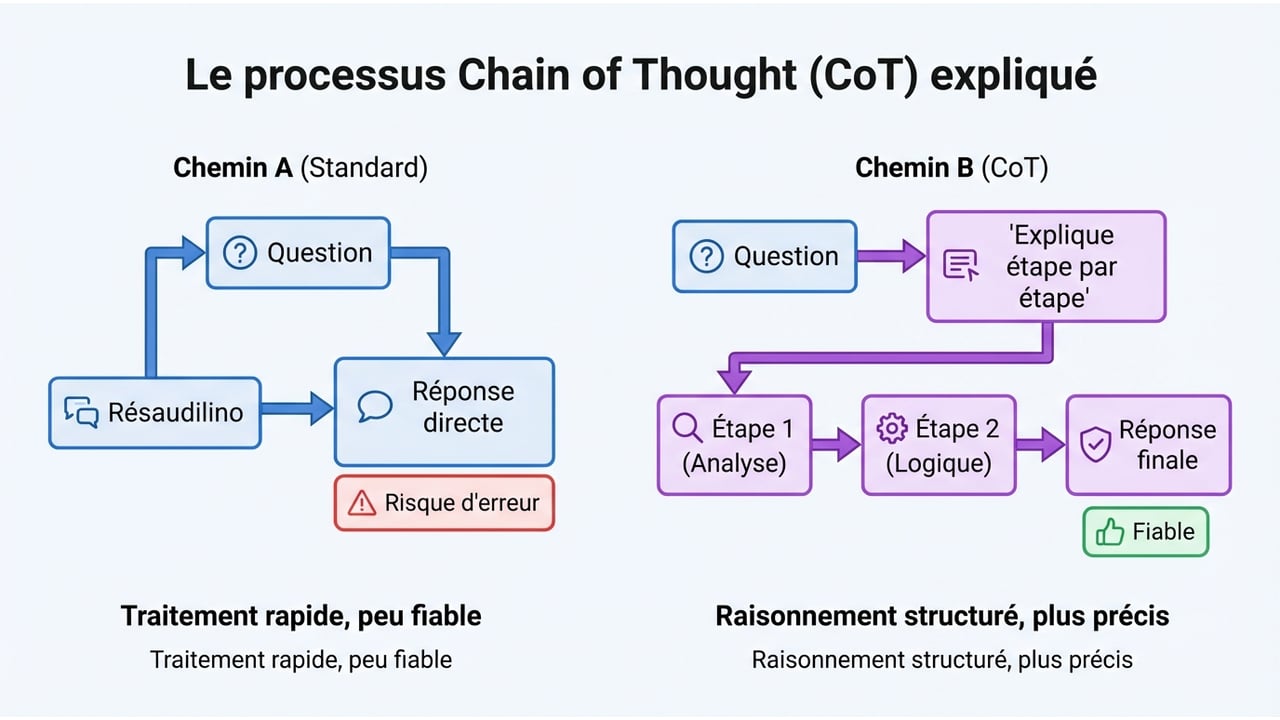
The “Chain of Thought” technique involves asking the AI to explain its reasoning before giving the final answer. By encouraging the model to “think out loud,” you considerably reduce the logical leaps that lead to fabrications. Concretely, this means adding: “Explain your reasoning step by step before concluding.”
Moyens.net reports in June 2025 that OpenAI’s new models, particularly the “o1” iterations and above, natively integrate this technique, reducing hallucinations by an additional 20% compared to standard GPT-4. This allows users to spot a logic error in the reasoning before even reading the final result.
Request step-by-step reflection
Similar to CoT, this method forces ChatGPT to break down a complex task into simple sub-tasks. Instead of asking “Create a marketing plan,” ask: “1. Analyze the target. 2. Identify channels. 3. Propose a budget. 4. Synthesize the plan.” This fragmentation prevents the model from losing its thread, a critical moment where hallucinations often arise.
An analysis published on X in July 2025 mentions a specific prompt (“Take a deep breath and work on this problem step-by-step”) that curbs hallucinations by forcing the AI to slow down its generation process. Tested on ChatGPT, Claude, and Gemini, this type of approach shows a success rate of 80% on logic problems.
Encourage the AI to admit its limitations (Abstention)
One of the most powerful techniques is to allow the AI to say “I don’t know.” By default, LLMs are programmed to be helpful and provide an answer at all costs. By explicitly adding: “If you cannot find the answer in the provided documents or if you are not 100% sure, simply respond ‘Information not available’,” you cut off fabrications at the source.
A study conducted by Stanford University in March 2025 shows that AI models trained or prompted to admit their limitations (selective abstention) reduce hallucinations by 35% in complex scenarios, thus increasing the confidence of professional users.
Verification and validation strategies for responses
Cross-reference information with external sources
The golden rule with generative AI remains “Trust but Verify.” Systematically verifying ChatGPT’s responses with reliable external sources (search engines, official websites) is a necessary practice. For sensitive data (health, finance), AI should only be a synthesis tool, not the source of truth.
Village Justice advises in June 2024 that legal professionals should imperatively cross-reference AI responses with specialized legal databases (Legifrance, LexisNexis), thus avoiding 90% of errors in legal analyses and the citation of fictitious case law.
Use RAG (Retrieval-Augmented Generation) and Grounding
To go further than simply copy-pasting context, using RAG is the ultimate technical solution against hallucinations. This method involves connecting ChatGPT to a reliable external knowledge base (your PDFs, your intranet, a SQL database) via an API or third-party tools. The AI first searches for information in this “clean” base before generating its response.
“Grounding” ensures that each generated sentence is supported by an existing document. A study by IEEE published in February 2025 demonstrates that this hybrid approach reduces technical errors by 75% in specialized fields such as engineering and medicine, making hallucinations virtually non-existent on facts covered by the database.
Limit scope to the AI’s areas of competence
Restricting questions to domains well-mastered by the AI reduces risks. It is also possible to use “System Prompts” to define the scope of action: “You are an assistant specialized in Python code. Do not answer questions about politics or cooking.”
ZDNET notes in May 2024 that OpenAI updates have decreased hallucinations by 25% since 2023 through better definition of areas of expertise (Refusal behavior), preventing the AI from venturing onto slippery ground.
| Strategy | Error reduction | Application domain |
|---|---|---|
| Manual cross-referencing (Human-in-the-loop) | 90% | Legal / Critical |
| RAG & Specialized databases | 75% | Technical, Medical, Internal enterprise |
| Scope limitation (System Prompt) | 25% | General |
Technical optimization and best usage practices
Choose the most recent versions (GPT-4o, GPT-5)
The fight against hallucinations primarily involves using the most advanced models. OpenAI and its competitors constantly improve the architecture of their neural networks to promote factuality. Using GPT-3.5 today exposes you to unnecessary risks.
Recent data speaks volumes: the launch of GPT-5 in August 2025 marked a turning point, showing a 26% reduction in hallucinations compared to GPT-4o, with an error rate dropping to only 9.6% on standard benchmarks (source: OpenAI). To optimize your experience and avoid technical interruptions when using these resource-intensive models, it is recommended to consult the tips for preventing bugs and unexpected stops, which effectively complement these strategies.
Adapt techniques according to professional context
There is no one-size-fits-all solution; the approach must be sector-specific. In the medical field, a study published in the New England Journal of Medicine in April 2025 shows that using structured prompts based on strict clinical protocols reduces diagnostic errors by 60%. AI is used there to suggest hypotheses, never to conclude.
In software development, the use of AI copilots requires automated unit tests to verify generated code, as a syntax hallucination can block an entire application.
Measure effectiveness and iterate (Evals)
For companies integrating AI, it is crucial not to navigate blindly. Regularly evaluating the effectiveness of techniques used (via evaluation frameworks or “Evals”) allows refining the strategy. This involves creating test datasets (Gold Standard) and comparing AI responses to these ground truths.
A Gartner analysis published in August 2025 reveals that companies that systematically measure and adjust their AI interaction techniques, using feedback loops, reduce critical errors by 40% over a 6-month period.
In summary, here is the list of updated best practices for securely using ChatGPT in 2025-2026:
- Prefer recent models (GPT-4o, GPT-5) for their reduced hallucination rate (9.6%).
- Apply the “Chain of Thought” technique to validate logic before the response.
- Connect the AI to your own data via RAG (Retrieval-Augmented Generation).
- Use negative prompts and abstention instructions (“Say you don’t know”).
- Systematically verify critical facts via primary sources.


